Meta open-sources Muse Gadgets for ESP32 and Pi hardware
Meta released Muse Gadgets on October 2: open-source ESP32 and Linux kits for building hardware around its Muse agent, plus 5,000 free Home Link dongles.
3 min read
By the numbers
- SDKs released: one for ESP32 boards, one for Linux
- 2
- Muse Home Link dongles Meta is giving away
- 5,000
- devices allowed per SDK token, per RuntimeWire
- 50
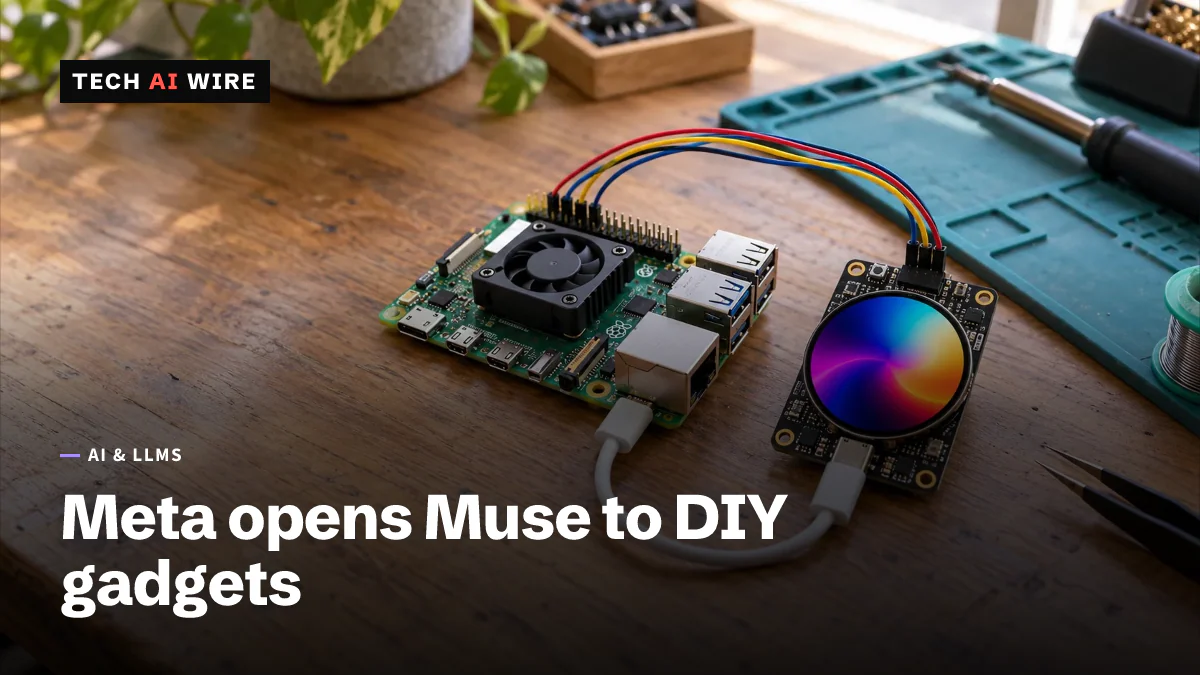
Meta released Muse Gadgets on October 2, 2026, an open-source project for building physical devices that talk to Muse, its personal AI agent. The project includes firmware for ESP32 boards and a software kit for Linux computers such as the Raspberry Pi. Meta is also giving away 5,000 units of its own device, the Muse Home Link. The move takes Muse off the phone and the browser and puts it on screens and gadgets people build themselves.
What Meta released
Nat Friedman, head of product at Meta's Superintelligence Labs, announced the project on X, TechCrunch reports. RuntimeWire notes that Friedman was previously GitHub's chief executive. His post drew nearly 30,000 views within hours, according to TechCrunch.
Muse is the agent Meta built to do tasks for people, such as booking travel, filling in forms and shopping. Muse Gadgets gives developers two kits for wiring it into hardware:
| Kit | Runs on | What it supports |
|---|---|---|
| ESP32 Device SDK | ESP32 microcontroller boards | Screens, audio in and out, sensors |
| Linux Device SDK | Raspberry Pi and other Linux computers | Full Linux devices |
An ESP32 is a cheap, low-power chip with built-in Wi-Fi, common in hobby electronics. An SDK, or software development kit, is the code and tools a developer builds on. Both kits are released under the Apache 2.0 license, which allows commercial use. RuntimeWire gives the repository as facebookincubator/muse-gadget-sdk on GitHub.
What people are expected to build
Meta suggested a few starting points, Engadget reports: a dedicated E Ink display, an HDMI dongle for a TV, and a small touchscreen accessory. TechMyMoney counts seven project ideas on the Muse Gadgets site. The site's examples include an ESP32 board with a 1.75-inch AMOLED screen.
Developers first claim an API token on the Muse Gadgets website. According to iPhone in Canada, they can then point a coding agent at the GitHub repository and have it write the device code. The same report notes an early build: developer Federico Viticci turned an Xteink e-reader into a pocket Muse display that attaches with MagSafe.
The Muse Home Link
Meta's own example device is the Muse Home Link. It is a small dongle powered over USB-C that joins a home network. From there, Muse can talk to TVs, speakers and any other device that accepts web requests over HTTPS, according to Engadget.
The Muse Gadgets site says the Home Link supports a local HTTP API and community-built skills. A skill is an add-on that teaches Muse to control a specific device, such as a smart light.
Meta made 5,000 units. They are free to active Muse subscribers in the United States, one per subscriber, first come, first served, according to RuntimeWire and TechMyMoney. Shipping is expected in October.
The fine print
The project is open source, but Meta keeps control of access. RuntimeWire reports that each SDK token is limited to 50 devices. Meta's terms say it can "change or withdraw access at any time." They also bar developers from building tokens into devices sold for money without Meta's written permission.
Meta also says the kits are not a supported product or developer platform. Community-built skills "should not be relied on for safety-critical tasks," RuntimeWire quotes the guidance as saying. The Muse Gadgets site states that the code is "provided as-is, without warranty."
What this means for developers
Treat Muse Gadgets as a prototyping kit, not a platform to build a business on. The code is Apache 2.0, but the service behind it is not. A device stops working when Meta withdraws its token, and the 50-device cap rules out selling a product without a deal with Meta.
Start with hardware you already own. An ESP32 board with a small screen or a spare Raspberry Pi is enough to try it. Keep the first build to displaying information, such as a status screen, before giving the agent any control.
Be careful with anything that acts on your home. Meta's own warning about safety-critical tasks matters here. Last week, a tester found that Muse synced Mac Messages after access was denied. An agent that can reach every HTTPS device on your network deserves the same caution. Put the Home Link on a separate guest network, and give it access only to the devices you want it to control.
Watch how fast rivals respond. OpenAI launched its always-on Dots agent to compete with Muse earlier this week. A hardware kit gives Meta a channel that a phone app alone does not.
Sources
- Meta wants your next gadget to be Muse-infused - TechCrunch
- Meta wants people to build their own Muse gadgets, too - Engadget
- Meta opens Muse to ESP32 gadgets and home-built interfaces - RuntimeWire
- Meta's Muse Lets You Build Your Own AI Gadgets - iPhone in Canada
- Meta Muse Gadgets Opens the AI Agent to DIY Hardware, With a Free Home Link for US Subscribers - TechMyMoney
Related articles

OpenAI launches Dots, an always-on rival to Meta's Muse
OpenAI launched its always-on Dots agent on September 29, 2026, to challenge Meta's Muse, which already has more than 3 million downloads.
Meta's Muse synced Mac Messages after access was denied
A tester who refused Meta's Muse access to Messages found about 187,000 rows of his Mac message history synced anyway. A separate zero-day hit its Mac app.

Meta's Muse adds computer control and a GitHub connector
Meta gave its Muse AI agent full computer control on Mac and new connectors, including GitHub, on September 23, 2026, drawing 1,500+ developer requests in a week.
The daily brief
Three to five stories a day, and what each one means for the people who build software. Free, no spam.