Linux 7.3 Btrfs fixes filesystem IDs and grub2 boot
A Btrfs change in Linux 7.2-rc1 made filesystem IDs unstable and broke OpenConnect key derivation. The fix touches 10 files.
3 min read
By the numbers
- Btrfs files changed in the merged pull
- 10
- lines added, against 13 removed
- 96
- kernel where the ID regression appeared
- 7.2-rc1
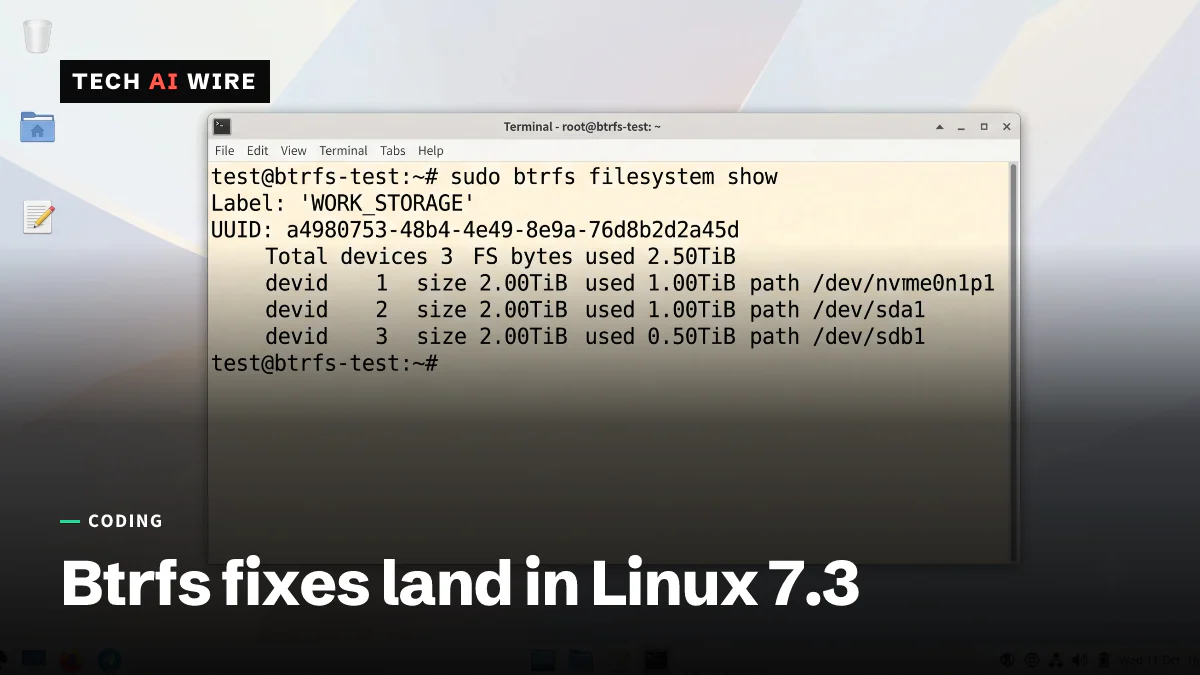
Linus Torvalds has merged a set of Btrfs fixes into the Linux 7.3 kernel, and two of them undo changes that broke working machines. One made the identifier Btrfs reports about itself unstable. The other stopped some computers from finishing their boot.
Btrfs is a file system built into Linux. It is the default choice on Fedora and on openSUSE, so a regression in it reaches ordinary desktops, not just servers. The pull request came from Btrfs maintainer David Sterba and carries the tag for-7.3-rc3-tag. Phoronix reports that the fixes land in the 7.3-rc4 release candidate.
Why the filesystem ID stopped being stable
Every mounted file system reports an FSID, short for file system identifier. Programs read it to tell one file system apart from another. Sterba's pull request lists the first problem as "filesystem id stability on default configurations".
Phoronix reports that the regression arrived in Linux 7.2-rc1. From that point the ID Btrfs reported on a default setup could change. Software that had stored the earlier value then read a different one.
The pull request names the casualty directly: "openconnect key derivation". OpenConnect is an open-source client for corporate VPNs, and NetworkManager ships support for it. Phoronix ties the breakage to that VPN support. When a key is derived in part from a value that suddenly changes, the key no longer matches.
Why some machines stopped booting
The second fix restores "/dev/root detection for initramfs-less boot systems with grub2", in Sterba's words.
An initramfs is a small temporary file system. The kernel loads it early in boot and uses it to find the real root file system. Most distributions ship one. Some setups skip it to boot faster or to keep the configuration simple.
Without an initramfs, the kernel has to work out on its own which device holds the root. Phoronix reports that this detection failed on Btrfs root file systems booted by GRUB2. A machine that cannot identify its root file system does not finish starting up.
What else is in the pull
The merge changes 10 files, adds 96 lines and removes 13. Sterba's message describes the rest as regular fixes, listed below with a plain-language note on the area each one touches.
| Area listed in the pull | What that part of Btrfs does |
|---|---|
| Compressed inline extents | Stores very small files compressed inside metadata |
| Zoned mode zone activation | Supports drives that must be written in fixed zones |
| Chunk item space validation | Checks the records that map storage chunks |
| Verity item removal | Cleans up fs-verity data, which verifies file contents |
| Free space tree rebuild | Handles errors while the free-space map is rebuilt |
| Reflink and hole punching | Copies blocks by reference, and frees ranges inside files |
| Block group iteration | Guards a walk over groups of allocated blocks |
| Error messages | Corrects wording in kernel log output |
The changed files include super.c, volumes.c, disk-io.c, inode.c, tree-checker.c, zoned.c and verity.c.
What this means for developers
Treat an FSID as a value that can change. If your code stores one and expects it to survive a kernel upgrade, that assumption just failed in production for VPN users. Read the identifier fresh, and have a path for the case where it differs from the one you saved.
If you maintain machines with a Btrfs root and no initramfs under GRUB2, do not roll Linux 7.2 onto them. Wait for a 7.3 kernel that carries this pull, or keep an initramfs in place as a fallback. Ubuntu 26.10 ships a pre-release 7.3, so check which release candidate your image contains before you trust it.
There is a wider lesson in the first bug. Any value that user space can read is an interface, even when no document says so. A kernel change that alters one will break software nobody thought to test.
Sources
Related articles
Linux 7.4 removes BFS, the UnixWare boot file system
A patch deleting 1,275 lines of BFS support is queued for Linux 7.4, one kernel cycle after EFS and FreeVxFS were dropped for the same reason.
Linux 7.2.6 leads a 9,000-patch stable kernel batch
Greg Kroah-Hartman released seven stable kernels at once, with more than 9,000 patches between them and over 1,800 in Linux 7.2.6 alone.

Linux plans to remove 247k lines of old ARM code
A kernel branch would delete about 247,000 lines by dropping deprecated 32-bit ARM platforms and the drivers only they used.
The daily brief
Three to five stories a day, and what each one means for the people who build software. Free, no spam.