Hyundai puts its Atria AI data flywheel into operation
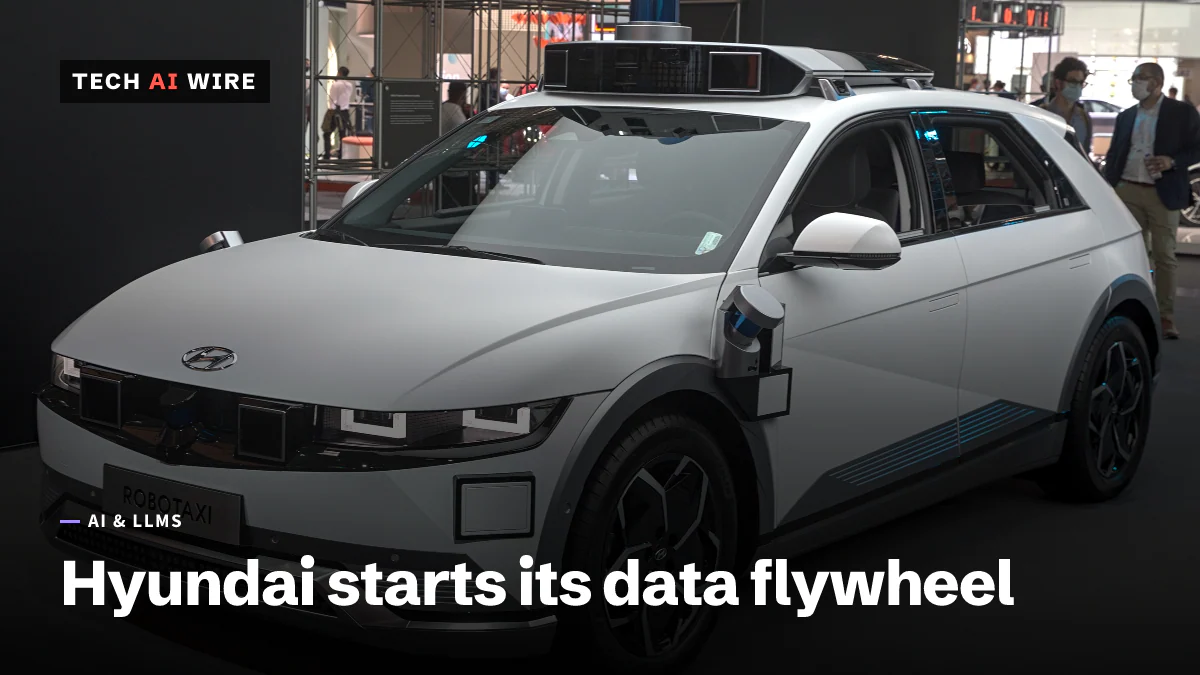
Hyundai says 40 dedicated cars now feed a training loop for its Atria AI driving system, with a Level 4 pilot in Gwangju due by the end of 2026.
4 min read
By the numbers
- cars dedicated to collection and verification
- 40
- vehicles the group sells each year
- 7M
- target for Atria AI in production
- 2029
Hyundai Motor Group said on September 13, 2026 that its autonomous driving "data flywheel" is now in full operation. The loop takes driving data off a dedicated fleet and mines it for the situations its models handle worst. It retrains on those, then pushes the result back into cars on public roads.
The system being trained is called Atria AI. It was built in-house by 42dot, the group's autonomous driving subsidiary. The word flywheel is doing real work here. Each turn of the loop is meant to make the next turn cheaper, because the cars themselves go find the next hard problem.
How the loop actually turns
Hyundai's announcement describes a cycle rather than a pipeline. The stages it names are these.
| Stage | What happens |
|---|---|
| Collection | A dedicated fleet gathers real driving data across markets |
| Hard example mining | The system picks out situations the model handles badly |
| Continuous training | Those examples go back into training, and results feed forward |
| Virtual validation | Real scenes are rebuilt in 3D and replayed as tests |
| Deployment | The improved model goes back into cars, generating new data |
Two stages there deserve plain language. Hard example mining means the fleet is not trying to record everything. It is trying to record the awkward cases, the ones the model gets wrong, because those are the only frames that teach it anything new.
Virtual validation is the other one. Hyundai says it rebuilds real road scenes using 3D Gaussian Splatting, a technique that reconstructs a scene from photographs as a cloud of soft blobs rather than as solid surfaces. Once a scene exists that way, you can replay it as often as you like and vary it, without putting a car back on the road.
The group also says development runs on a follow-the-sun schedule, with teams in South Korea and the United States handing work across time zones for a 24-hour cycle. Sensor standardization is being coordinated with Motional, and the group names NVIDIA DRIVE Hyperion 10 as the platform it is standardizing on. A framework called Data Union is meant to let Hyundai Motor, Kia, 42dot and Motional share data in one format.
The fleet is smaller than you would guess
The striking number is how few cars feed this. Hyundai says 40 vehicles are dedicated to data collection. Kyunghyang Shinmun reports the split as 20 for collection and 20 for verification, each gathering about 80 hours a week, for roughly 1,600 hours across the fleet.
That paper puts the figure next to Tesla, which it says collects about 4.38 million hours of driving data a day. The gap is not close, and Hyundai's answer is scale it does not yet use: the group sells about 7 million vehicles a year across roughly 190 countries. Leadership expects to pass rivals' cumulative data within five years of starting mass production.
Minwoo Park is president of the group's Advanced Vehicle Platform division and chief executive of 42dot. "Competitiveness is determined by how much data you secure, how quickly you learn and how effectively you can reflect those results," he said. Seonggyun Jeong, who leads 42dot's Atria group, put the same idea more bluntly: "High-quality data is where good autonomous driving AI ultimately starts."
What ships, and when
| Target | Date |
|---|---|
| Level 4 pilot in Gwangju, with Korea's transport ministry | By the end of 2026 |
| Level 2+ production, NVIDIA-based | First half of 2028 |
| Level 2++ production, NVIDIA-based | Second half of 2028 |
| Atria AI in production | Second half of 2029 |
The sources disagree on that last row. Hyundai's own announcement describes the 2029 Atria AI target as Level 2++. Kyunghyang Shinmun reports it as Level 3+. The difference matters, because Level 3 is the point where the car, not the driver, is responsible for watching the road.
The group is also pushing a Vision-Language-Action model, which joins what the car sees to reasoning in language and then to a driving action. "VLA is core technology for Physical AI going beyond simply driving," said HeeSeok Lee, who leads 42dot's Trion group.
What this means for developers
The reusable idea is hard example mining, and it is not specific to cars. Most teams with a model in production are still sampling data more or less at random. Hyundai's claim is that a small fleet beats a large one if it only keeps the examples the model fails on. If you run a model that sees production traffic, the question worth asking this week is whether you can detect and store your own failures automatically.
Treat the 3D reconstruction step as the interesting engineering, not the demo. Rebuilding a real scene so it can be replayed and varied is how you turn one expensive road test into many cheap ones. The same pattern applies to any system that is costly to test live, which is most of them.
Read the autonomy-level conflict as a reminder about announcements. Two accounts of the same briefing disagree about whether a 2029 product watches the road or the driver does. When a roadmap is this far out, the level is a target rather than a commitment. Nevada's decision to approve thousands of paid robotaxis showed how fast the ground can move underneath one.
Finally, note who is not in the loop. This is a closed flywheel: Hyundai's cars, Hyundai's subsidiary, Hyundai's format. Data Union standardizes sharing inside the group, not outside it. If you were hoping the automakers would converge on an open format for driving data, this is evidence pointing the other way.
Sources
Related articles

Nvidia posts $96.2B quarter and guides to $108B for Q3
Nvidia reported $96.2 billion in revenue, up 106% in a year, with data centre sales at $89 billion. Its own release guides to $108 billion for this quarter.
Nvidia's DLSS 5 ships this week for RTX 50 cards at a 50-60% cost
Nvidia's DLSS 5 arrives this week with NBA 2K27, limited to RTX 50 cards. Reports put the performance cost at 50 to 60 percent, inverting what DLSS was for.
Nvidia's Groq 3 LPX inference chip enters full production
Nvidia put its dedicated inference accelerator into full production, splitting agent workloads so GPUs handle context and the new chips handle token generation.
The daily brief
Three to five stories a day, and what each one means for the people who build software. Free, no spam.