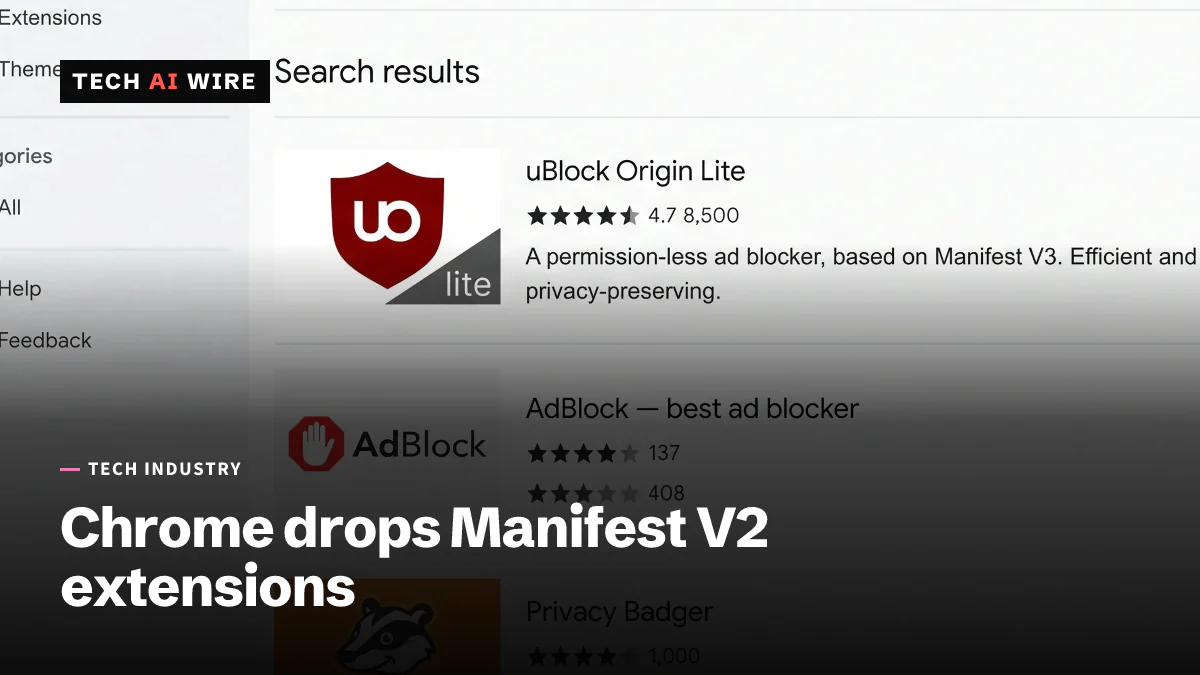
Google pulls every Manifest V2 extension from the Chrome Web Store
The last Manifest V2 extensions, classic uBlock Origin among them, are gone from the Chrome Web Store. Copies already installed keep running, but they get no updates.
4 min read
By the numbers
- the release that deleted the last MV2 flags
- Chrome 151
- MV2 extensions Brave now self-hosts
- 4
- updates an installed MV2 extension can still get
- 0
Google has removed the last Manifest V2 extensions from the Chrome Web Store, including the classic version of uBlock Origin. Extensions already installed keep working, but they can no longer be updated or reinstalled. For anyone who still relied on Chrome finding the old ad blocker for them, that route is now closed.
Manifest V2 is the older rulebook Chrome extensions were written against. Manifest V3 replaced it. The two reports that cover the removal disagree by one day on when it happened: the Brave community post says September 1, 2026, while gBlock says August 31, 2026.
What actually changed
The extensions did not stop running. They stopped being available.
According to the Brave community post, Manifest V2 extensions installed on Chrome 138 or earlier stay installed. What they lose is everything after that. They cannot receive updates, and they cannot be reinstalled from the Chrome Web Store once removed. The same post notes that users can no longer find or install these extensions through the store even on browsers that still support Manifest V2.
That distinction matters for an ad blocker in particular. A filter list that never updates gets worse every week, because the sites it filters keep changing.
The road here, version by version
This was a long removal, not a sudden one. gBlock lays out the sequence.
| Date | Chrome version | What changed |
|---|---|---|
| July 24, 2025 | 138 | The option to re-enable Manifest V2 extensions disappears |
| June 30, 2026 | 150 | The kExtensionManifestV2Disabled flag is removed |
| July 28, 2026 | 151 | The last legacy flags go, including AllowLegacyMV2Extensions |
| August 31 or September 1, 2026 | - | The remaining MV2 extensions leave the Chrome Web Store |
Android Authority reported the middle step in June 2026. It said the "Allow legacy extension manifest versions" flag was gone from stable Chrome, which ended the workarounds people had used to keep the old extensions installable.
Google's reasoning is on the record there too. Android Authority attributes the removal of the kExtensionManifestV2Disabled feature to Chrome engineer Devlin Cronin. The stated reasons were plain. Keeping Manifest V2 alive was complex, it created technical debt, it carried security risks, and it caused multiple bugs.
What uBlock Origin Lite gives up
There is a Manifest V3 version, and it is not the same product.
uBlock Origin Lite is the adaptation built for the new rules. Per gBlock, it drops dynamic filtering and custom filter lists, and cosmetic filtering is turned off by default. Dynamic filtering is the part that lets you make blocking decisions while a page is loading. Cosmetic filtering hides page elements rather than blocking requests.
The limit sits in the API itself. The old webRequest API let an extension inspect and change network traffic as it happened. Manifest V3 replaces it with declarativeNetRequest. There, an extension registers static rules in advance and the browser applies them. According to gBlock, those rules cannot depend on the top-level context. So a rule cannot easily behave differently based on which site you are actually visiting.
Where you can still get the classic build
Other browsers have not all followed. The Brave community post says Brave self-hosts four Manifest V2 extensions on its own backend: uBlock Origin, AdGuard, uMatrix and NoScript. Users enable them from there rather than from Google's store.
Android Authority reported in June 2026 that Firefox has committed to supporting Manifest V2 indefinitely. That report also listed other browsers as still supporting it at the time. Browser positions have moved since June. Treat any list of holdouts as a snapshot, not as today's state.
What this means for developers
If you ship a Chrome extension and any part of it still targets Manifest V2, the distribution question is settled. There is no store listing to fall back on, and no flag to tell enterprise users to flip. Porting is the only path that keeps you installable.
If you depend on webRequest to make decisions at request time, budget real work rather than a rename. The new API wants your rules up front. Rules that vary by the top-level site are the ones that translate worst. Write the tricky cases down first and check each against the new API before you estimate the port.
There is a testing consequence worth acting on today. Colleagues running old Chrome with an old extension are frozen on whatever version they had, so bug reports from them describe code that can never be patched. Ask which browser and which extension build a report came from before you spend time on it.
For your own browsing, decide deliberately rather than by drift. Staying on Chrome means uBlock Origin Lite and its narrower feature set. Keeping the classic build means Firefox, or Brave's self-hosted copies. Doing nothing means an installed extension that quietly ages out, which is the one option with no upside.
Sources
- Google removes all MV2 extensions from web store - Brave Community
- Chrome 151 kills Manifest V2 - uBlock Origin is done - gBlock
- Chrome users are losing their best ad-blocker - Android Authority
Related articles
Edge begins dropping Manifest V2, leaving uBlock Origin to Firefox
Microsoft Edge has begun phasing out Manifest V2 extensions, cutting off classic uBlock Origin and leaving Firefox as the last major browser still running it.
BragJack: one extension can hijack browser AI agents
BragJack lets one malicious extension take over the AI assistants in Chrome, Edge, Comet, Opera Neon and Claude in Chrome. Two CVEs, over $20,000 in bounties.
Arc browser shuts down December 22 as users move to Dia
The Browser Company will shut down Arc on December 22, 2026. Accounts are deactivated that day, and personal data is deleted within 30 days.
The weekly digest
One email every Friday with the week's top stories from all six desks: AI, dev tools, coding, the tech industry, startups and what's next. Free, no spam.