CoreWeave bond yield passes 16% as AI debt fears grow
CoreWeave shares fell 15.46% on October 14 and a 2031 bond briefly yielded over 16% as investors questioned how the AI cloud carries its debt.
3 min read
By the numbers
- share drop on October 14
- 15.46%
- brief yield on a bond due October 2031
- 16%+
- revenue backlog, roughly, per filings
- $104B
- of revenue from committed take-or-pay contracts
- 98%
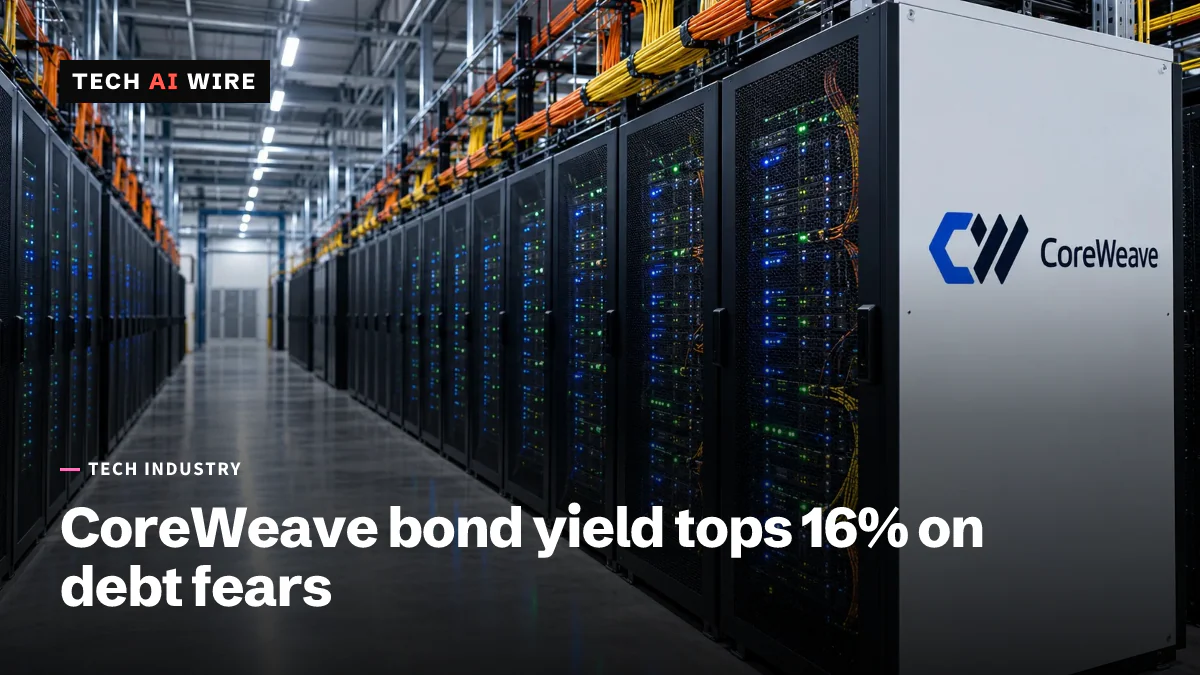
CoreWeave, a cloud company that rents out AI computing power, lost 15.46% of its stock value on October 14, 2026. A day later, one of its bonds briefly yielded more than 16%. The slide matters because CoreWeave's customers include OpenAI and Meta, and its debt has become a test of how the AI build-out is being paid for.
What happened in the market
The selling ran across the whole week. Fortune reports the stock fell 15.46% on Wednesday and another 5.62% in after-hours trading, then recovered slightly on Thursday.
On Thursday, the yield on a CoreWeave dollar bond due October 2031 briefly topped 16%, according to Reuters as cited by TECHi. A bond's yield rises when its price falls, so a yield that high shows buyers want a big reward for the risk of not being paid back. On Friday, the shares were down more than 11% again in midday trading.
The pressure spread to similar companies. TECHi cites Reuters putting Nebius down about 10% on Friday, with Applied Digital and IREN each down about 9%.
Fortune ties Wednesday's drop to a chart that investor Chamath Palihapitiya posted on X, showing the bond yield touching 15%. "Is the AI build-out creating a private credit bubble?" he asked.
How much CoreWeave owes
The two reports read the company's filings slightly differently. Fortune puts total debt at $35.6 billion plus $16.3 billion in operating leases, about $52 billion together. TECHi cites about $35.1 billion of debt and roughly $16.3 billion in leases as of June 30, 2026.
| Figure | Amount |
|---|---|
| Debt, as of June 30, 2026 | $35.1 billion (TECHi) or $35.6 billion (Fortune) |
| Operating lease liabilities | About $16.3 billion |
| Liquidity, including $5.52 billion cash | $15.55 billion |
| Q2 2026 revenue | $2.575 billion |
| Q2 2026 net interest expense | $640 million |
| Q2 2026 net loss | $626 million |
| Revenue backlog | About $104 billion |
The interest bill is the number that stands out. In the second quarter, CoreWeave paid $640 million in net interest while reporting a $626 million net loss, according to TECHi. Revenue more than doubled from a year earlier.
CoreWeave's own June filing warns it may need more debt or stock sales "on terms that may not be favorable," TECHi reports.
The case for and against
CoreWeave's defense is its contracts. "98% of our revenue is from committed, take-or-pay contracts," the company said, as quoted by Fortune. Take-or-pay means a customer pays for reserved capacity whether it uses it or not.
The risk is concentration. Fortune reports that three customers made up 72% of second-quarter revenue. "It's going to matter significantly who owes you money," said Evan Schlossman of Neostellar Capital, an early investor.
Fortune also quotes Deutsche Bank on borrowing costs. AA-rated AI companies borrow at about 5% to 5.5%, while CoreWeave carries a BB+ rating, below investment grade. Deutsche Bank's Jim Reid wrote that AI-linked financing costs "are not excessive relative to the rest of the credit stack."
CoreWeave cofounder Brannin McBee told the Financial Times he wants to borrow more from insurance companies, Fortune reports. He called that pool of money "unlimited." Analysts at Evercore kept an outperform rating on the stock, TECHi reports.
The wider worry is about "neoclouds," newer cloud firms built only to rent GPUs. Fortune cites a Gartner estimate that 80% of them will stop operating independently by 2030.
What this means for developers
If your team rents GPUs from CoreWeave or another neocloud, nothing changes today. Contracts stand, and the company says 98% of its revenue comes from committed contracts. But price the risk into your plans.
Keep your workloads portable. Jobs that run on standard containers and open tools are far easier to move to another provider than jobs tied to one provider's custom stack.
Watch for terms, not headlines. If borrowing gets more expensive for GPU clouds, check renewal offers for longer commitments, bigger prepayments or fewer discounts.
If you buy AI capacity through a larger provider, ask your account team where your workloads physically run. A supplier's financing trouble can reach you through someone else's contract.
Sources
Related articles
Meta claims $3.9B research tax credit on AI data centers
Meta saved $3.9 billion in 2025 by calling AI data centers research 'pilot models' under a 1981 tax credit, the New York Times reports.
Microsoft reportedly exits Nscale's Loughton data center
Microsoft has reportedly dropped its deal to anchor Nscale's Loughton site, where power may not arrive until the 2030s, weeks before a $3 billion IPO.
Beige Book: AI slows hiring in five Fed districts
The Fed's October Beige Book says firms in five of its 12 districts cut staff by attrition, delayed hiring or planned fewer jobs after investing in AI.
The weekly digest
One email every Friday with the week's top stories from all six desks: AI, dev tools, coding, the tech industry, startups and what's next. Free, no spam.