Claude Code, Codex, and Cursor agree on a tool only 42% of the time
A study of 16,893 coding-agent sessions found Claude Code, Codex, and Cursor pick the same third-party tool only 42% of the time. Stripe beat PayPal in every session where both qualified.
3 min read
By the numbers
- coding-agent sessions measured across 75 synthetic repositories
- 16,893
- of sessions where all three agents picked the same tool
- 42%
- of Codex sessions that used web search, versus about 30% for Claude Code
- 94%
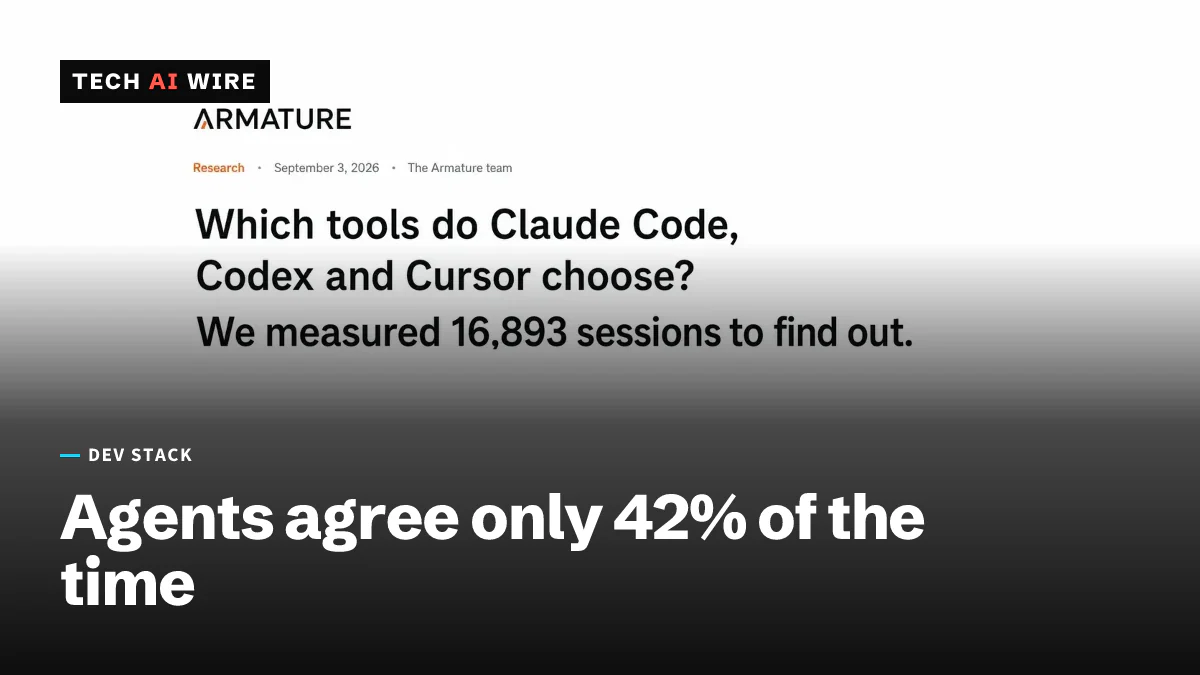
Claude Code, Codex, and Cursor pick the same third-party tool in only 42% of comparable situations. That comes from a study of 16,893 coding sessions, published by Armature on September 3, 2026. A coding agent often chooses a payment processor, a voice API, or an authentication service on your behalf. Which agent you used decides more of that outcome than you might expect.
Armature builds tools for companies that want their own product picked by coding agents. Its study measured how agents behave when nobody is watching.
How the test worked
The researchers built 75 synthetic repositories across 10 programming languages and 51 valid codebases, covering 18 industry sectors. Each repository used a fake company name and a fake commit history. The lockfiles were real, checked against actual package registries like npm, so the agents worked against genuine dependency data.
Across those repositories, the team ran 1,163 prompt variations, producing 16,893 total sessions. Ecosistema Startup reports the setup also rotated through four user personas and three sandbox environments, and used a separate AI model to simulate human code review.
The tools themselves diverged sharply
The headline number is the 42% agreement rate. The rest of the time, the three agents made three different calls.
One concrete example, reported identically by both sources: PayPal appeared as an eligible option in 139 sessions. It was never chosen. Stripe won 124 of those same sessions.
| Behavior | Codex | Claude Code |
|---|---|---|
| Uses web search | 94% of sessions | About 30% of sessions |
| Search style | Narrows with site: operators | Broader, unrestricted queries |
| Pages browsed per search | Baseline | About 3x more than Codex |
| Builds a custom solution in-house | 10% of sessions | 19% of sessions |
Codex's high search rate paired with narrow, operator-restricted queries suggests it leans on the open web to confirm a specific answer quickly. Claude Code searches less often, but when it does, it reads more broadly before deciding.
The in-house number is the one worth sitting with
Claude Code chose to write custom code instead of adopting a third-party tool in 19% of sessions, against 10% for both Codex and Cursor.
That is not a small gap. Nearly one in five times a third-party option existed, Claude Code built its own version instead. Whether that reflects better judgment, or just a bias toward generating code over researching alternatives, is not something this study can settle. It measured outcomes, not reasoning.
What this means for developers
Do not assume your coding agent's tool choice is neutral or universal. If you ask a different agent to solve the same integration problem, expect a real chance of a different outcome. That could be a different vendor, a different library, or a from-scratch implementation, not just different code style.
Treat an agent-chosen dependency as a decision to review, not a default to accept. A 42% agreement rate across three well-known agents tells you something. The other 58% of the time, a choice was made by something closer to house style than to a considered evaluation of your options. Check licensing, cost, and maintenance status before that dependency ships.
If you are building a developer tool or API yourself, this study is a preview of a real distribution channel. An agent's default answer to "what should I use for X" is becoming a genuine acquisition path. The study suggests documentation quality and web discoverability shape that answer as much as the product itself does.
Watch the build-versus-buy split by agent if you standardize tooling across a team. A team that mixes Claude Code with Codex or Cursor should expect more custom, in-house code from the Claude Code side of that split. That split comes from which agent wrote the code, not from how hard the task was.
Sources
Related articles
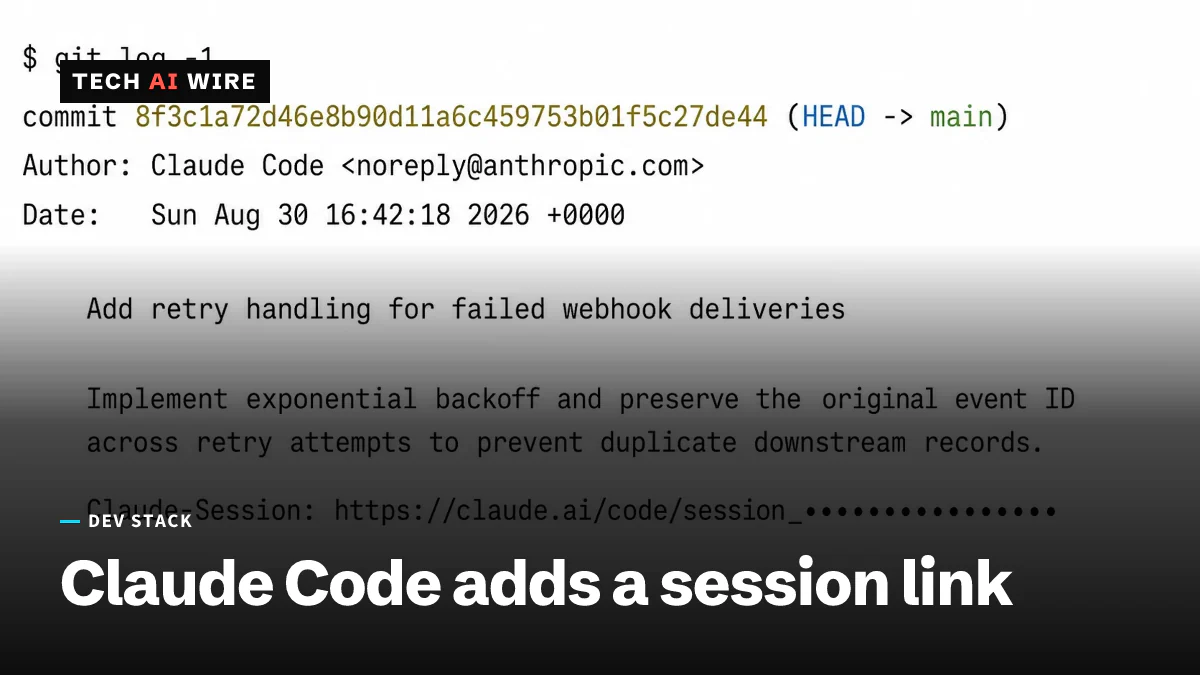
Claude Code puts a session link in commits unless you opt out
Claude Code appends a Claude-Session: trailer linking to its own chat to commits and pull requests. It defaults to on, and developers want it opt-in.

Claude Opus 4.7 agents invent games on a virtual island
An MIT study left 13 Claude Opus 4.7 agents alone on a virtual island for 30 hours. They invented games, then beat fresh copies on new tasks.
JetBrains: developers say agents now write 47% of their code
A JetBrains survey of 15,509 developers finds agents fully write 47% of code on average. 90% use an agent weekly, and Claude Code leads adoption at 39%.
The weekly digest
One email every Friday with the week's top stories from all six desks: AI, dev tools, coding, the tech industry, startups and what's next. Free, no spam.