Apple rejects astronomy app Dark Hours for 'astrology' - twice
Apple rejected Terry Godier's astronomy app Dark Hours as astrology, and its App Review Board upheld the call citing a tarot feature the app doesn't have.
3 min read
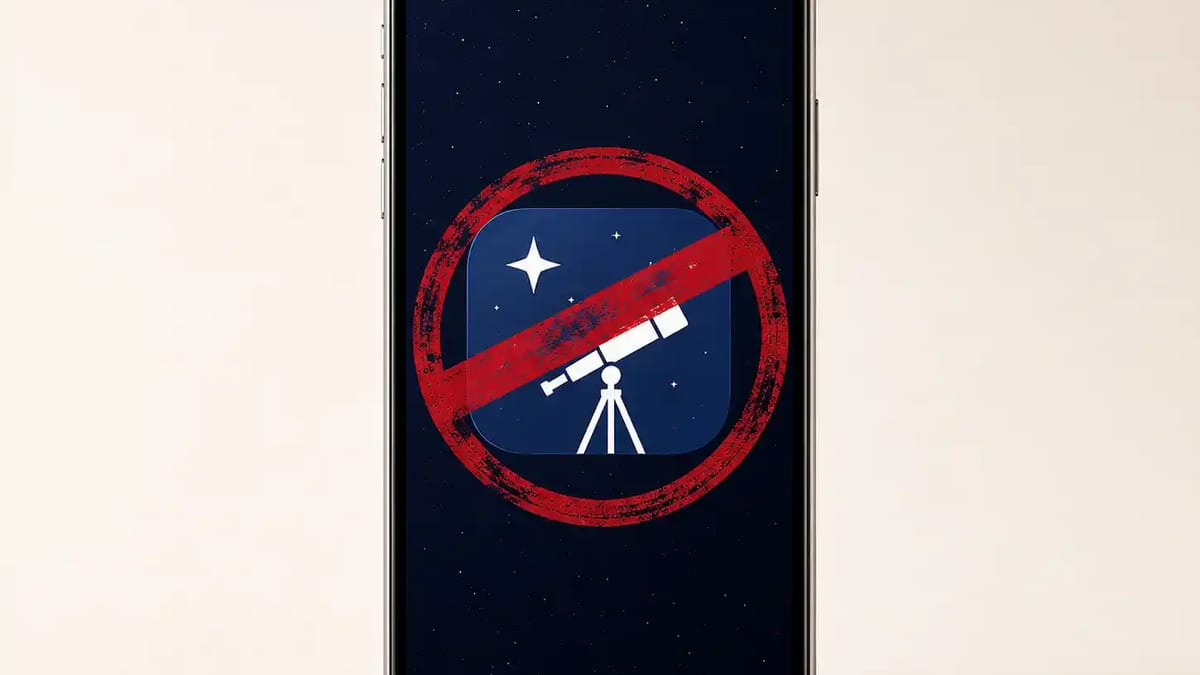
Apple rejected Dark Hours, an astronomy app for observing celestial objects, on the grounds that it "pertains to astrology" - and when developer Terry Godier appealed, Apple's App Review Board upheld the rejection by claiming the app "includes a live tarot reading feature," according to accounts published August 7, 2026 by Daring Fireball and developer Michael Tsai. The case matters beyond one app: it is a documented example of Apple's highest review-escalation path affirming a factually wrong rejection.
What happened
Dark Hours is an astronomy app built by Terry Godier, with a native iOS design using Apple's Liquid Glass UI, per John Gruber's Daring Fireball post. Apple's initial App Review rejection classified it as astrology. Godier escalated through Apple's appeal process up to the App Review Board - the final stop for disputed rejections - and the board's response, quoted in both posts, was: "We understand that the app includes a live tarot reading feature."
Godier disputes that flatly. The app "has no tarot function, no horoscopes, and nothing that I, or anyone else I've asked, would associate with astrology," he said, as quoted by Daring Fireball. Gruber's own assessment after looking at the app: "It is instantly obvious that it pertains to the science of astronomy and has absolutely nothing to do with astrology."
Why developers are paying attention
The criticism collected in Michael Tsai's roundup goes past the individual mistake to the system that produced it. Godier argues the review process is inconsistent in both directions - approving low-quality apps such as ChatGPT wrappers and games loaded with excessive ads while rejecting a legitimate scientific tool. Gruber's characterization of the appeal outcome was blunter: "This is straight out of Kafka."
The detail that makes this case notable is where the error was affirmed. Individual reviewer mistakes are a known quantity in App Store development. Here, according to both accounts, the App Review Board - the escalation path that exists specifically to correct such mistakes - introduced a new incorrect claim (the tarot feature) rather than catching the original one.
What this means for developers
If you ship on iOS, the practical takeaways are concrete:
- Do not assume the App Review Board re-examines your app from scratch. In this documented case, the board upheld a miscategorization with a justification the developer says describes a feature that does not exist. Build your appeal as if you must disprove the original rejection and preempt adjacent misreadings - spell out what your app is not, with screenshots.
- Category-adjacent confusion is a real rejection risk. An astronomy app was read as astrology. If your app's domain has a superficially similar, more heavily regulated or restricted neighbor (astronomy/astrology, education/gambling-adjacent games, wellness/medical), address the distinction explicitly in your review notes before the first submission.
- Public documentation moves cases. Both posts appeared on August 7, 2026 and were picked up widely by developer aggregators the same day. Neither source reports a reversal by Apple at the time of writing, but the historical pattern Gruber's "rejection of the week" framing implies - high-profile rejections drawing public scrutiny - is a lever developers have used when the formal process fails. Keep records of every review exchange so you can publish an accurate timeline if you choose to.
- Plan release timelines around review risk. An appeal that runs to the App Review Board and fails leaves an app with no App Store path other than resubmission. If a launch date matters, budget for at least one rejection cycle in any category where a misclassification like this one is plausible.
Neither Daring Fireball nor Tsai's post reports any comment from Apple beyond the review responses quoted above.
Sources
- App Store Rejection of the Week: Dark Hours - Daring Fireball
- Dark Hours Rejected From the App Store - Michael Tsai
Related articles
iOS 27.2 gives EU apps an alternative tracking prompt
The new prompt is mandatory in 5 EU countries and optional elsewhere. It drops the word track, and developers may ask again after a year.
Swift 6.4 ships async defer and makes Swift Build default
Swift 6.4 lands async code in defer blocks, module selectors, and a 40x faster WebAssembly bridge, with Swift Build now the default in the package manager.

iOS 27 ships with Xcode 27 and no dropped iPhones
Apple shipped six platform updates on September 14, 2026, claiming app launches up to 30% faster, and iPhone 11 still makes the cut.
The daily brief
Three to five stories a day, and what each one means for the people who build software. Free, no spam.