Android Studio Rabbit 2 opens the IDE to 40+ agents
Android Studio Rabbit 2 is stable with 40+ outside coding agents, Claude and Codex among them. Android CLI now installs as a plugin for both.
4 min read
Drafted with AI from the sources linked in this article, then fact-checked and edited by Claire Whitmore before publishing. How we work
By the numbers
- ACP-compatible coding agents supported in Android Studio
- 40+
- faster UI tasks with android preview, in Google's internal tests
- 77%
- fewer tokens at most on those UI tasks, per Google
- 3x
- official Android skills across more than 20 areas
- 30+
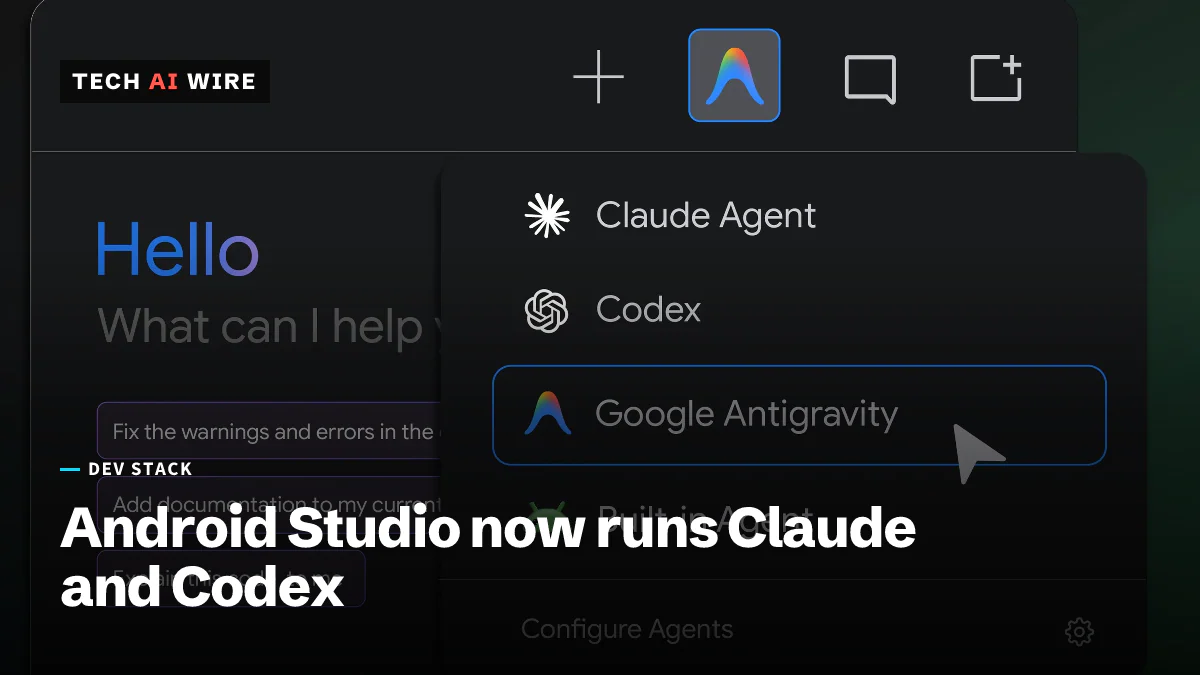
Google released Android Studio Rabbit 2 as a stable build on October 28, 2026, at Android Dev Summit. It lets developers run more than 40 outside coding agents, including Anthropic's Claude Agent and OpenAI's Codex, inside the IDE. Google also shipped Android CLI as an official plugin for Claude Code and Codex, so those agents can build and test Android apps without opening Android Studio at all.
The shift matters because Google is no longer asking Android developers to use only its own Gemini assistant. The Android Developers Blog post, written by Adarsh Fernando, group product manager for Android developer tools, frames it as "any agent, any model."
How Bring Your Own Agent works
The feature is called Bring Your Own Agent, or BYOA. It is stable in Rabbit 2 and lives under Settings > Tools > AI > Agents. From there, a developer picks which agents to install.
It works through the Agent Client Protocol, or ACP. ACP is an open standard for how a coding agent talks to an editor. Any agent that speaks it can plug into Android Studio, and Google counts more than 40 that do. FoneArena lists Claude Agent, Codex and Google Antigravity among them.
Developer Gabriel Anhaia, writing on DEV Community, adds two practical details. You can install several agents and switch between them. Each one signs in with its own account and usage limits.
He also points to a data question. Outside agents fall under their own vendor's data terms, not Google's. Google's Gemini Enterprise terms on code retention and training are not stated to cover Claude Agent or Codex.
Android CLI as a plugin for Claude Code and Codex
The second half of the news happens outside the IDE. Android CLI is Google's command-line tool for Android work. Google says it runs "in any terminal, with any agent harness, and in your CI pipelines."
It now installs as an official plugin. For Claude Code, from a terminal:
claude plugin marketplace add android/android-cli-plugin
claude plugin install android-cli@android-cli-plugin
For Codex:
codex plugin marketplace add android/android-cli-plugin
codex plugin add android-cli@android-cli-plugin
An Android plugin for Google Antigravity sits in the Antigravity marketplace. Google stopped selling Gemini Code Assist on October 9 and is moving its AI coding help to Antigravity.
The plugin gives an agent commands for most of an Android workflow:
| Command | What it does |
|---|---|
android init | Installs the android-cli skill for the agent |
android preview | Renders Compose Previews without an emulator or the IDE |
android device remote | Provisions a remote test device |
android profiler leakcanary | Runs the LeakCanary memory-leak tool |
android skills list | Lists official Android skills |
android docs search | Searches the Android Knowledge Base |
Skills are packaged instructions an agent loads for a specific job. Google says it has published more than 30 of them across more than 20 areas. Examples include r8-analyzer, play-policy-insights and android-permissions-security.
What Google's speed figures show
Google gives two performance claims, both from its own internal testing.
| Workflow | Google's result |
|---|---|
UI tasks using android preview | 77% faster, up to 3x fewer tokens |
| Memory-leak fixes with LeakCanary via Android CLI | Almost 2x faster, up to 25% fewer tokens |
The blog post's chart for the leak test names Claude Opus 5.5 as the model. Google has not published the task set behind either figure, Anhaia notes. In a keynote demo, Claude Code ran a list of user journeys on separate devices at once, found memory leaks, fixed them and re-ran every journey. Google says the demo video is sped up.
What else shipped, and at what stage
Not everything announced is ready for production use. The blog post and FoneArena give these stages:
| Feature | Stage |
|---|---|
| Bring Your Own Agent in Rabbit 2 | Stable |
| Android XR Emulators | Stable |
| R8 Configuration Analyzer | Built into AGP 9.3 |
| AppFunctions | Beta, per FoneArena |
| Fix with AI for memory leaks | Canary |
| Views to Compose Migration Assistant | Canary |
| Lightbuild | Early preview |
| Jetpack Keep | Alpha |
| Memory-leak command in Android CLI | Coming soon |
Change Review, which reviews pending changes from an agent or from Git, also ships in Android Studio. Google gave it no stage label.
What this means for developers
- Pick an agent on purpose. If your team already pays for Claude Code or Codex, you can now use it in Android Studio rather than adding Gemini. Compare cost and output on one real feature before you standardize.
- Check the data terms first. Code sent to an outside agent follows that vendor's rules. Get security or legal sign-off before you point Claude Agent or Codex at a private repository.
- Try
android previewin CI. Rendering Compose Previews without an emulator is useful even without an agent. It could speed up the UI checks your pipeline already runs. - Gate remote devices.
android device remotegives an agent real hardware. Anhaia argues those calls deserve approval prompts, and that is a sensible default. - Treat the numbers as a starting point. The 77% and 3x figures come from an unpublished task set. Time your own UI tasks with and without the plugin.
The Canary features are the ones to watch next. Fix with AI and the Views to Compose assistant target two of the slowest chores in Android work, and neither has a stable date yet.
Sources
Related articles
JetBrains: developers say agents now write 47% of their code
A JetBrains survey of 15,509 developers finds agents fully write 47% of code on average. 90% use an agent weekly, and Claude Code leads adoption at 39%.

Claude Code 2.1.317 widens its game-recreation rule
Claude Code 2.1.317 widens its rule against recreating existing games. A Tech AI Wire check of four builds shows when the rule arrived and what changed.
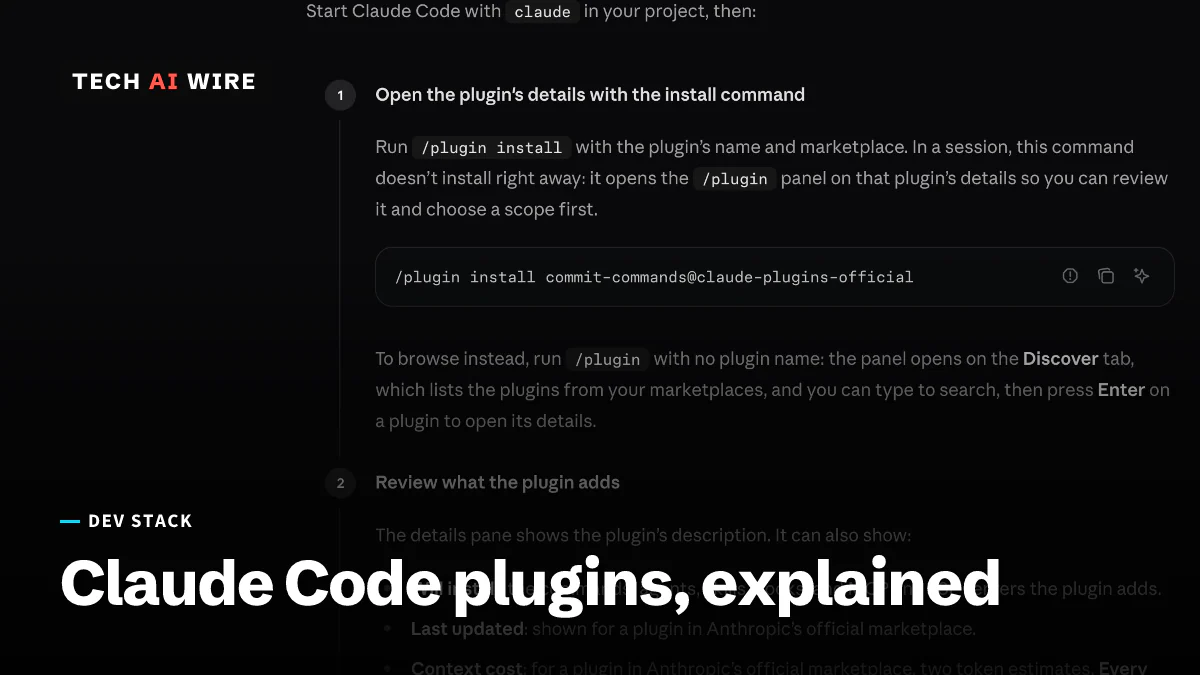
Claude Code plugins, explained
What Claude Code plugins add, how /plugin installs them, and a hands-on test of version 2.1.317's validator, which flags 2 problems in a bare plugin.
The weekly digest
One email every Friday with the week's top stories from all six desks: AI, dev tools, coding, the tech industry, startups and what's next. Free, no spam.