Android developer verification starts in four countries
Since September 30, 2026, apps in Brazil, Indonesia, Singapore and Thailand need a Google-verified developer to install from seven app stores.
4 min read
By the numbers
- launch countries: Brazil, Indonesia, Singapore, Thailand
- 4
- app stores that now check developers
- 7
- one-time fee for a full developer account
- $25
- devices a free limited account can reach
- 20
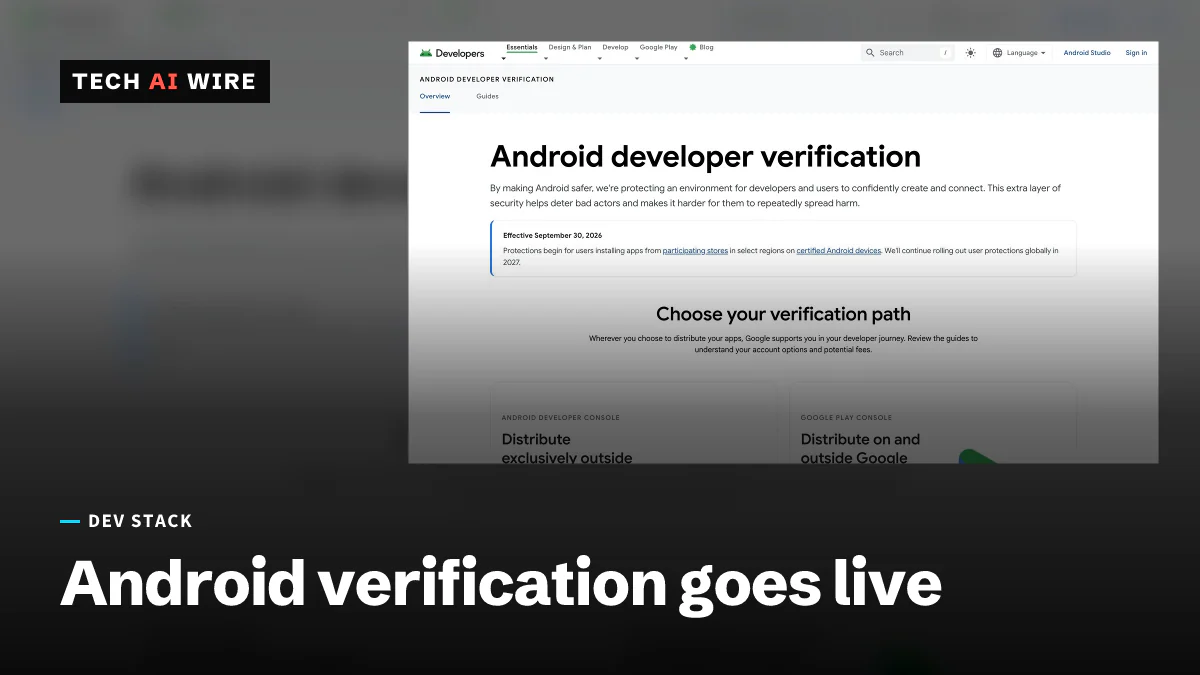
Google's Android developer verification rule took effect on September 30, 2026, in Brazil, Indonesia, Singapore and Thailand. On certified Android phones in those countries, an app now installs or updates from seven app stores only if its developer has registered with Google. It is the first time the rule has been enforced anywhere, and Google plans to take it worldwide in 2027.
A certified device is one that ships with Google's own apps and services. The change affects anyone who publishes Android apps for those markets, whether on Google Play or on a phone maker's own store.
What changed on September 30
Google's developer verification page says enforcement covers certified devices running Android 7 or later in the four launch countries. Gadget Hacks reports that this first phase is limited to seven app stores:
- Google Play
- HONOR App Market
- OPPO App Market
- Samsung Galaxy Store
- Palm Store
- vivo V-Appstore
- Xiaomi GetApps
The check runs through a system service called Android Developer Verifier. Gadget Hacks explains that it shows up on phones as com.google.android.verifier and is "a legitimate Google system service, not malware." The two sources differ on which phones get it. Google's page puts enforcement at Android 7 and later, while Gadget Hacks says the verifier service was pushed to devices running Android 8 and above.
A verified developer is not the same as a safe app. Gadget Hacks notes that it only means "an identity check has passed" and the app is registered to that developer. It does not mean Google has vetted the app itself.
Who has to register, and what it costs
Google launched the developer tools, a free account tier and an install workaround in August 2026, ahead of enforcement. There are now two kinds of account.
| Account | Cost | ID needed | Reach |
|---|---|---|---|
| Full distribution | $25, one time | Government-issued ID | General release |
| Limited distribution | Free | None | Up to 20 devices |
The limited account is meant for students, teachers and hobbyists, Google says. A full account means registering each app's package name, the unique ID such as com.example.app. It also means registering the fingerprint of the signing certificate, the key that proves an update came from the same developer, Gadget Hacks reports.
Most Play developers have little to do. Google says Google Play registers 99% of its apps automatically. Open-source apps get their own registration process, according to Google's page.
What still works without verification
Sideloading is not banned. Gadget Hacks calls the rule "a new checkpoint added to the install path, not a ban on sideloading itself."
Three routes stay open. First, installs over ADB, the Android Debug Bridge tool developers use to push apps from a computer, keep the same "workflow and experience." Second, an "advanced flow" lets power users install apps from unverified developers. Gadget Hacks reports a 24-hour waiting period for that path, which ADB skips. Google describes the delay as giving "critical time and space" to interrupt coercion scams, where someone pressures a victim into installing an app.
Third, this phase covers only the seven stores above. Installing a downloaded APK file directly is not covered yet, Gadget Hacks reports. That also leaves out F-Droid, the open-source app store that shipped version 2.0 last week, because it is not one of the seven.
What this means for developers
Check your status in the Android Developer Console or the Google Play Console today. If you sell in Brazil, Indonesia, Singapore or Thailand, an unregistered app on a participating store can no longer be installed or updated there. Updates matter as much as new installs: existing users will stop getting your fixes.
Register every package you ship, not just your main app. Side builds, white-label versions and apps you publish only on Galaxy Store or Xiaomi GetApps each need a package name and signing fingerprint on file. Keep your signing keys safe, because the fingerprint ties your identity to every future update.
Use the free tier for testing and small groups. A limited account covers up to 20 devices with no ID and no fee, which suits beta testers, classrooms and internal tools. Anything larger needs the $25 account.
Keep ADB in your workflow. Development builds pushed over ADB skip verification and the 24-hour wait, so local testing does not change.
Plan for 2027 now. Google says verification will expand to all certified Android devices worldwide, and Gadget Hacks reports that the second phase covers all install sources. If you hand out APK files from your own website, that path is open today but is scheduled to close. Register before the global rollout, rather than when your users start seeing blocked installs.
Sources
- Android developer verification - Android Developers
- Google Android Sideloading Restrictions: Sept 30 Explained - Gadget Hacks
- What Is the Android Developer Verifier App and Why Is It on Your Phone? - Gadget Hacks
Related articles
Chrome moves to a two-week release cadence
Chrome 153 starts a two-week milestone cycle, down from four. Google says Chrome 149 and 150 alone fixed 1,072 security bugs as LLMs find flaws at scale.
Google pauses its open-source bug bounty over AI reports
Google stopped taking OSS VRP bug reports on October 1 after a surge of AI-generated submissions, most of them invalid. An update is due in Q1 2027.
Denmark CPR breach exposes 8.8 million personal records
Attackers misused a Danish company's legal access to the CPR register and pulled names, addresses and ID numbers of 8.8 million people in September.
The weekly digest
One email every Friday with the week's top stories from all six desks: AI, dev tools, coding, the tech industry, startups and what's next. Free, no spam.