1Password breach: what the GitHub intrusion took
1Password says a hijacked employee GitHub account let an attacker copy customer names, emails and recovery tokens. Our field-by-field reading.
4 min read
Drafted with AI from the sources linked in this article, then fact-checked and edited by Claire Whitmore before publishing. How we work
By the numbers
- day 1Password began investigating the intrusion
- Nov 19
- characters in invitation and recovery codes, up from 6 digits
- 10
- businesses that use 1Password, per TechCrunch
- 200,000+
1Password, the password manager TechCrunch says serves millions of customers and more than 200,000 businesses, said on November 25, 2026 that an attacker broke into some of its backend systems. The way in was an employee's corporate GitHub account. The attacker copied customer names, email addresses and some invitation and recovery tokens, but 1Password says no vault, password or Secret Key was exposed. Those details are what a convincing phishing email needs, so users should watch their inboxes.
What happened at 1Password
1Password's notice says it "began investigating indications that an attacker gained access to an employee's corporate GitHub account" on November 19, 2026. GitHub is the service where 1Password stores and shares its source code.
The attacker used that account to reach the code and push malicious code to backend services. Those services then downloaded what 1Password calls administrative data about its customers. According to the notice and the outlets that read it, the attacker also copied source code from private repositories. They also got into the CI/CD system, the automated pipeline that builds and ships the company's software and holds infrastructure secrets.
1Password published the notice six days after the investigation began. TechCrunch says a 1Password spokesperson did not immediately respond to its questions.
What 1Password's notice says was taken
The notice splits the data into what the attacker copied and what stayed out of reach. Here is each item, with a plain-language description and who it touches.
| Data copied | What it is | Who is affected |
|---|---|---|
| Names and email addresses | The name and address you use to sign in | "A subset" of customers, per 1Password |
| Account and user IDs | Internal numbers that identify your account | Same subset |
| Account creation and last sign-in times | When the account was made and last used | Same subset |
| Public keys | The public half of your encryption key pair, "public by design," per the notice | Same subset |
| SRP parameters | Values used when 1Password checks a sign-in; the notice says they "cannot be used to access your account" | Same subset |
| Invitation, provisioning and recovery tokens | Codes inside emails that invite you to an account or recover it | "A small number of users," notified directly |
| Other non-secret account metadata | "Version numeric identifiers" and "file numeric identifiers" from 1Password's internal systems | Same subset |
The list of what was not reached is just as specific. The notice's summary says: "Your vault data, the items in them, and the keys that protect them are safe and were not affected." It adds that 1Password "does not have access to your password or secret keys." The notice also lists account recovery keys and the 1Password apps and browser extensions as not affected.
The outlets differ on scope. TechCrunch's report names only names, emails, creation dates and sign-in times. BleepingComputer, Help Net Security, SiliconANGLE and The Hacker News also list the keys, tokens, metadata and source code. None of them gives a number of affected customers.
Why the stolen tokens are limited
The tokens are the most sensitive item on the list, because they sit inside invitation and recovery emails. The notice says a token "is not able to get access to the account by itself." It works only with a single sign-on login or a six-digit code sent to the account's registered email address.
1Password has now lengthened those codes from six digits to ten letters and numbers. It also disabled the employee's GitHub account, revoked the stolen token and restored clean versions of the affected service. It rotated or revoked every internal credential that may have been exposed, and brought in independent security experts. The notice says 1Password "validated no internal evidence of user account takeovers" using the exposed tokens.
What is still unknown
Several questions are still open:
- How the GitHub account was taken over. TechCrunch says this is unclear, and SiliconANGLE says it was left unexplained.
- How many customers were affected. 1Password has not said, per TechCrunch, Help Net Security and SiliconANGLE.
- Who the attacker is. The Hacker News calls it "an unknown threat actor."
SiliconANGLE notes this is not 1Password's first disclosed intrusion. In October 2023 an attacker reached its Okta tenant with session data stolen from Okta, and no user data was found to have been compromised, the outlet says.
What this means for developers
1Password's own advice is short: "You do not need to update anything in your 1Password account." The risk now is phishing that uses your real name and email address.
- Distrust any 1Password email you did not trigger. The notice warns about "unexpected emails about 1Password, such as invitations or account recovery requests that you did not initiate." Open the app or type the address yourself instead of clicking a link.
- Never type your Secret Key into a page you reached from an email. The notice says 1Password "will never contact you to ask for your account password or Secret Key."
- Admins: check pending invitations and recovery requests. Cancel any that nobody on the team started, and tell staff a fake invitation may arrive.
- Treat this as a CI/CD lesson. One hijacked GitHub account was enough to push code to backend services and reach a pipeline that holds secrets. Check who can push to your deploy branches without review, and how fast you can rotate CI secrets.
- Watch the notice for updates. 1Password says it will update the post "if we find anything that changes what we've said here."
Sources
- Update on a security incident involving 1Password's backend systems - 1Password
- 1Password said hackers broke into its internal systems, but customer passwords are safe - TechCrunch
- 1Password customer data stolen after employee GitHub account breach - BleepingComputer
- 1Password breached through hijacked employee GitHub account, customer names and emails stolen - Help Net Security
- Attacker used 1Password employee's GitHub account to copy customer records - SiliconANGLE
- 1Password Hacked, Customer Data and Source Code Stolen in GitHub Account Breach - The Hacker News
Related articles
iOS 27.2 is out with Siri AI memory and 163 fixes
Apple released iOS 27.2 on October 26 with Siri AI memory, an Excluded Apps privacy setting, five new Siri languages and fixes for 163 vulnerabilities.
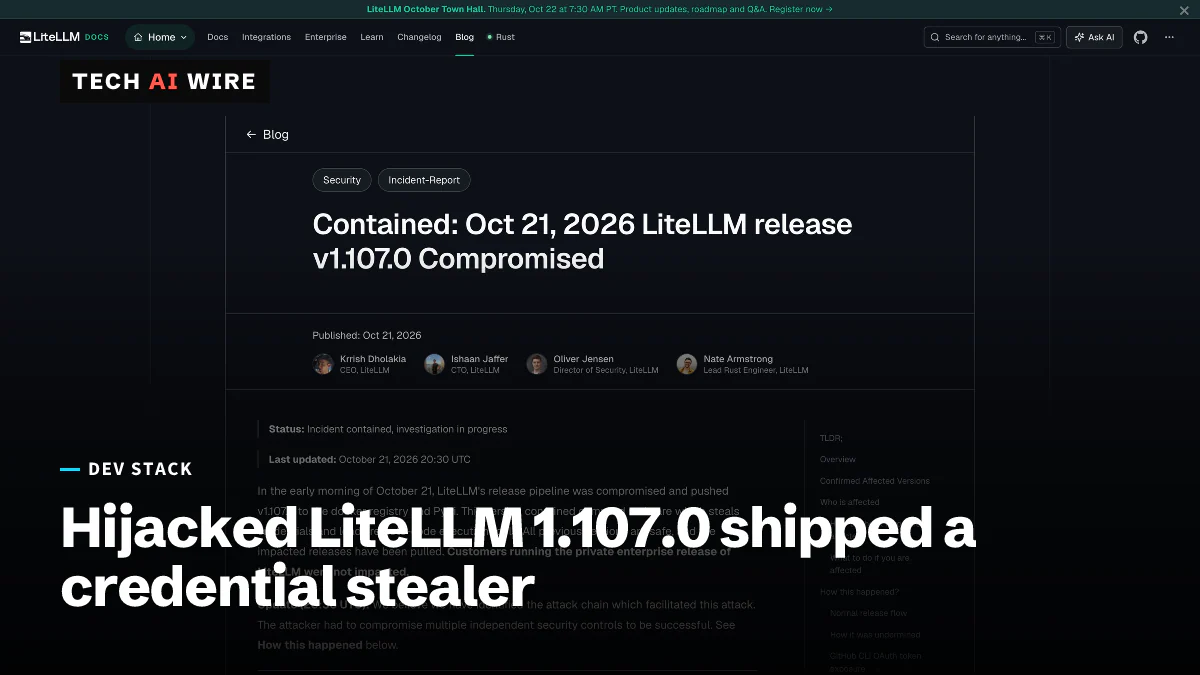
LiteLLM 1.107.0 hijacked to ship a credential stealer
Malicious LiteLLM 1.107.0 wheels were live on PyPI from 11:39 to 13:23 UTC on October 21, 2026, and ran a credential stealer at every Python start.
AdFection: Citizen Lab finds spyware delivered via ads
Citizen Lab says Israeli firm Discover-Tech used targeted ads to deliver Candiru spyware with no click. At least 45 Al Jazeera devices were targeted.
The weekly digest
One email every Friday with the week's top stories from all seven desks: AI, dev tools, coding, the tech industry, startups, what's next and tech travel. Free, no spam.