Town raises $108M at $1B for AI assistants that team up
Town raised a $108M Series B at a $1B valuation four months after launch, so its per-worker AI assistants, called Townies, can hand work to each other.
4 min read
By the numbers
- Series B, co-led by Forerunner and Menlo
- $108M
- valuation after the round
- $1B
- growth in paying teams since July, per Town
- 9x
Town, a San Francisco startup that gives every employee an AI assistant, raised a $108 million Series B at a $1 billion valuation on October 19, 2026. Forerunner Ventures and Menlo Ventures co-led the round, about four months after Town's public launch in June. The money funds a bet that work assistants should cooperate across a team, not just serve one person.
What Town's Townies do
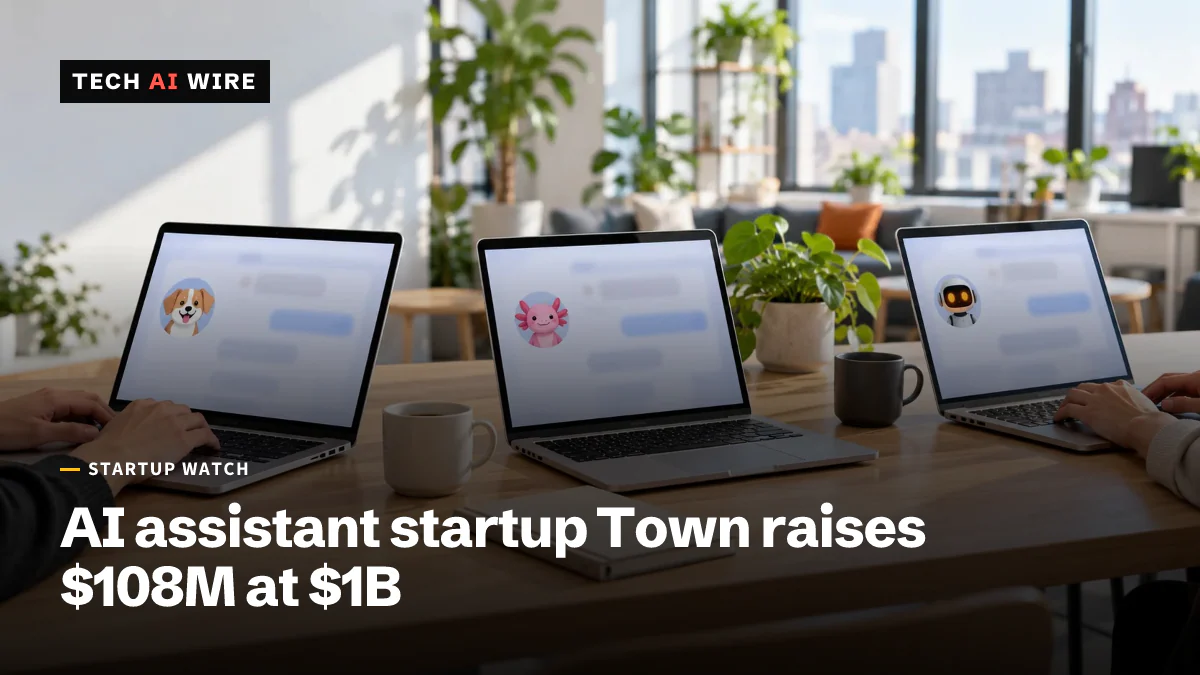
Each Town user gets a personal assistant called a Townie. According to Town's announcement, it connects to the user's email, documents, calendar and core work systems. Town's own blog says each Townie learns its owner's contacts, work and writing style.
The new part is teamwork. Townies can ask each other questions and hand off work, so one person's assistant can get an answer from a colleague's assistant. They can also email and text people outside the company, such as customers, partners and job candidates.
Town says each Townie acts for its user, shares only what that user would share, and asks permission. Decisions that need human judgment go back to a person. The company's blog gives examples:
- Drafting a message in an executive's voice, for that executive to send.
- Finding a teammate who knows a target contact, then booking the meeting.
- Testing a draft presentation against teammates' Townies before the real meeting.
- Pushing a process update to every Townie on a team at once.
"AI has made each of us faster on our own. Now, it can make teams faster together," co-founder and CEO Jean-Denis Greze said, as quoted by The Next Web.
The round and who is in it
| Round | Amount | When | Led by |
|---|---|---|---|
| Series A | $55 million | June 2026 | Andreessen Horowitz, per Dealroom |
| Series B | $108 million at a $1 billion valuation | October 19, 2026 | Forerunner Ventures and Menlo Ventures |
Existing investors Andreessen Horowitz and First Round Capital joined the Series B. So did Better Tomorrow Ventures, Precedent.vc, Scribble Ventures, Serena Ventures and Sparked Ventures. The angel investors include Scott Belsky, Romain Huet and Varun Anand.
Dealroom, a startup data company, says the round ranks in the top 1% by size among 85 US Series B rounds over the past 48 months. Menlo partner Shawn Carolan tied the deal to an old bet in Town's press release: "In 2008 Menlo backed Siri to transform the user interface to the Internet."
Town is the second AI agent company this week to reach that mark: Daytona hit a $1 billion valuation on a $60 million round.
Growth claims, and what they leave out
Town's press release says the company reached seven-figure annual recurring revenue within weeks of its June launch. Since July 2026, it says, paying customers have grown 4 times and paying teams 9 times. The Next Web adds that "thousands of businesses" use Townies every day.
All of those figures come from Town. No source gives a customer count, a revenue figure or a price, so the multiples have no base to measure against.
Greze co-founded Town with Tony Vincent. RuntimeWire describes Greze as a former chief technology officer at Plaid, the banking data company.
How Town handles company data
An assistant that reads every inbox raises an obvious question: who owns what it learns? Town's answer is the customer. "We believe that this context is a critical asset and should belong to the company that built it," its blog says. Users who leave can take that context with them.
The press release lists the rest of the policy:
- Data from connected accounts does not train AI models by default.
- Town uses models from "several major AI labs" and picks one per task. It does not name them.
- It holds a SOC 2 Type 2 report, an independent audit of its security controls.
- It publishes its data processing agreement, the contract that governs customer data.
What this means for developers
Test the sharing rules before you roll it out. "Shares only what the user would share" is the claim that matters most when assistants talk to each other. Set up two test accounts. Ask one Townie for something that sits in the other person's private thread, and see what comes back.
Decide who reviews outside messages. Townies can email and text customers and job candidates. Agree on which messages need a human to approve them, and check that every message an assistant sends is logged.
Read the data processing agreement before you connect real inboxes. Town does not name its AI providers, and that agreement is where the subprocessors, the outside companies that touch your data, should be listed. Ask for the export format too, since Town says the context belongs to you.
Budget for a pilot, not a rollout. Town's growth figures are relative, and no public price list appears in any source. Start with one team, measure the hours it saves, and only then compare the cost per seat.
Sources
- Town Raises $108M Series B at a $1B Valuation to Bring AI Assistants to Whole Teams - GlobeNewswire (Town)
- Town raises $108M at a $1B valuation so AI assistants can work as a team - The Next Web
- Town raises $108M at $1B valuation to make AI assistants work as a team - Dealroom
- Town raises $108M at a $1B valuation for its workplace AI assistants - RuntimeWire
- Operate at the speed of AI - Town
Related articles
Otter.ai takes $320M in repayable General Catalyst funding
Otter.ai took $320 million from General Catalyst's Customer Value Fund. It is repaid with interest from marketing-driven revenue, so no shares were sold.
Instinct raises $250M at $2.5B for an agent that acts for you
Index Ventures and Benchmark led a $250 million Series B at a $2.5 billion valuation. Security researchers are raising alarms about the assistant's permissions.
Legora raises $550M Series E at an $8.8B valuation
Legora raised a $550 million Series E at an $8.8 billion valuation on October 21, 2026. The legal AI startup says its revenue run rate tops $200 million.
The weekly digest
One email every Friday with the week's top stories from all six desks: AI, dev tools, coding, the tech industry, startups and what's next. Free, no spam.