Supabase raises $150M and buys Turso for agent databases
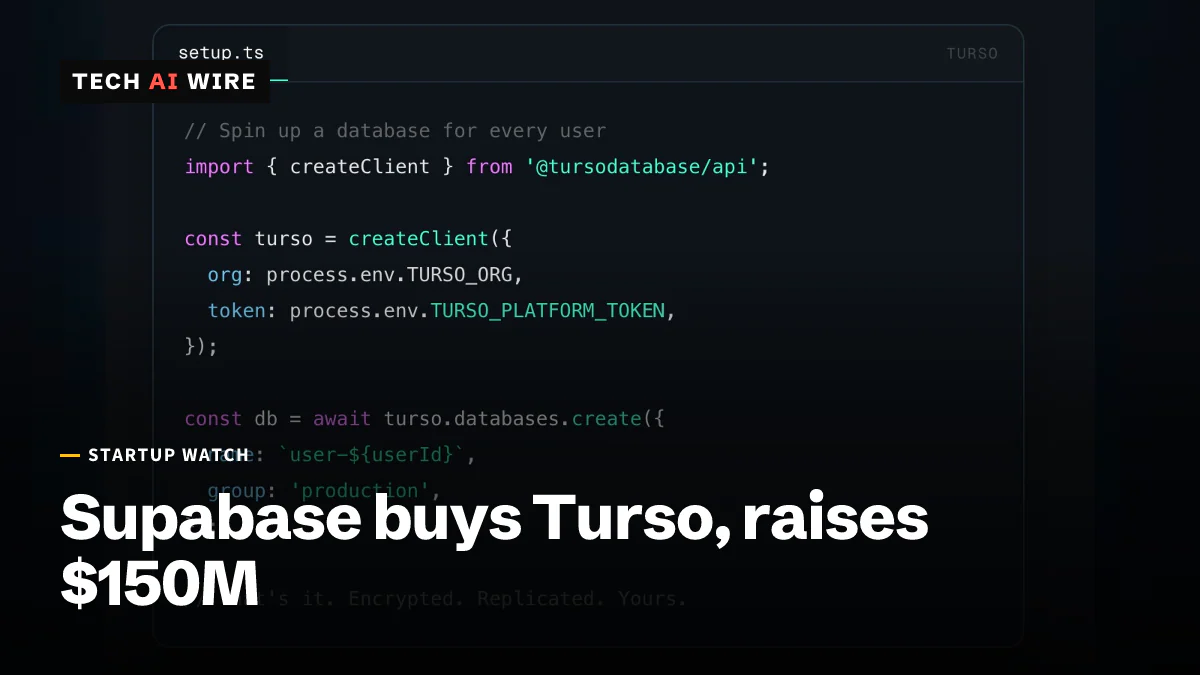
Supabase raised $150M four months after a $500M Series F and is buying Turso, whose SQLite tech lets one server run millions of small databases.
3 min read
By the numbers
- new funding, led by GIC
- $150M
- of new Supabase databases created by agents or AI tools
- 70%
- new databases created on Supabase each month
- 4M
- developers on the platform, per the company
- 13M
Supabase announced on October 2, 2026 that it has raised $150 million and is buying Turso, a database company built on SQLite. The deal is a bet that AI agents, not people, will create most new databases. Supabase says agents and AI tools already create 70% of the new databases on its platform.
Supabase sells hosted backends built around Postgres, the widely used open-source database. Turso works on SQLite, the small database engine that keeps a whole database in a single file. The two companies are betting that agents need both.
The funding round
The investment firm GIC led the new round, according to the company's press release. CapitalG, Alphabet's growth fund, joined along with IronArc and SquarePeg. The round comes about four months after a much larger one.
| Round | When | Amount | Detail |
|---|---|---|---|
| Series F | About four months earlier | $500 million | $10.5 billion valuation |
| New round | October 2, 2026 | $150 million | Led by GIC; no new valuation given |
None of the announcements we read gives a price for Turso.
Why agents changed the numbers
The growth figures explain the timing. Supabase says it adds more than 1 million new users and 4 million new databases each month. It counts 13 million developers on the platform in total. In June it reported 600% year-over-year growth in databases created.
The Supabase blog post frames the scale another way. The company is launching more than one million databases a week. Many are for prototypes, explorations, dashboards and small apps that agents build.
That pattern breaks the usual cost model. A traditional database gets its own server or a dedicated slice of one. Ventureburn describes that setup as "agonizingly slow and financially ruinous" for agent workloads. An agent that needs a database for a short task cannot wait long for one, or pay for it all month.
What Turso brings
Turso's design lets a single server manage millions of databases, according to the Supabase post. CityBiz describes the same idea in plainer terms. Turso can run large numbers of isolated, low-cost databases without a dedicated machine for each one.
That makes a "database per agent" practical. Each agent, user or task gets its own small database instead of sharing tables in one big one. The Supabase post puts the goal in one line: "Agents should be able to create a database as easily as creating a file."
Turso's customers include Superhuman, Sauna.ai, CTO.new and Mastra. Founder Glauber Costa and co-founder Pekka Enberg are joining Supabase to lead its work on agent infrastructure.
Costa described Turso's goal as serving billions of databases. Being part of Supabase "will bring this goal closer," he said in the release. Supabase chief executive Paul Copplestone was blunter: "The future is agents."
What happens to each product
Supabase says Turso will keep operating and will be integrated into the wider Supabase platform. Supabase will keep building around Postgres, and Turso will keep working on SQLite. The combined pitch, in Supabase's words, is to bring "the Supabase experience to every agent."
What this means for developers
If you run on Turso today, nothing changes on day one. Supabase says the product keeps operating. Still, an acquired product's pricing and roadmap often shift within a year. Keep your export path tested, and read every pricing email closely.
If you run on Supabase, Postgres stays the core of the platform. What is new is a second, cheaper kind of database aimed at short-lived agent work. If your product lets an agent create projects or sandboxes, watch for a Supabase option that gives each one its own SQLite database.
If you build agent tools, the 70% figure is the number to plan around. Agents create databases far faster than people, and many are thrown away. Decide now how you will name, limit, back up and delete them. Four million new databases a month on one platform means cleanup is a design problem, not an afterthought.
The strategic read is a split between two engines. Postgres holds the data a business keeps for years. SQLite-style databases hold the scratch state an agent needs for minutes. Supabase now owns a team for each.
Sources
Related articles
Flow Engineering raises $50M Series B at a $750M valuation
Flow Engineering, whose AI agents check CAD and requirements for hardware teams, raised $50M at a $750M valuation a year after its $23M Series A.
EliseAI raises $350M at $4B for housing and health AI
EliseAI raised $350 million at a $4 billion valuation, nearly double its 2025 price, as its AI runs leasing work for one in six U.S. apartments.
Armadin raises $255.5M for AI attack agents at $2.5B
Kevin Mandia's Armadin raised $255.5 million at a valuation above $2.5 billion to sell AI agent swarms that attack company networks before criminals do.
The daily brief
Three to five stories a day, and what each one means for the people who build software. Free, no spam.