Rust funds six maintainers as Clippy's review backlog hits 300
The Rust Foundation Maintainers Fund is now paying six people to maintain Rust, backed by Google, AWS and OpenAI. Clippy's backlog sits near 300 pull requests.
4 min read
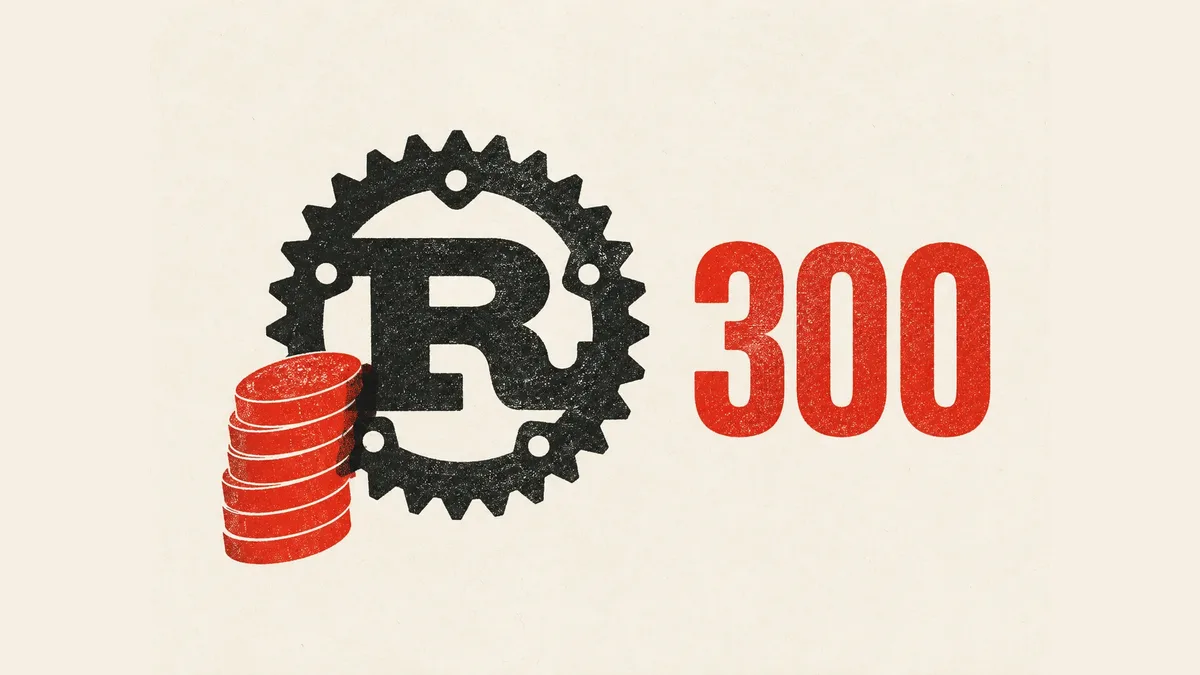
- rust-analyzer, with a funded reviewer
- 10 PRs
- rust-analyzer, after they left
- 110 PRs
- Clippy, August 2026
- 300 PRs
The Rust Project named its first six Maintainers in Residence on 26 August 2026. They are paid from the Rust Foundation Maintainers Fund, so the work is a job rather than spare-time volunteering. The announcement also names nine Rust teams it considers critically underfunded. That list, and the backlog numbers behind it, are the useful part for anyone who ships Rust.
The programme comes from RFC 3931, a Rust design proposal published on 23 February 2026. The fund itself launched on 2 June 2026. Google, AWS, OpenAI, the Rust Project Leadership Council, and individual donors pay for it, according to the announcement.
Who is funded, and at what level
Six people were selected, split across three levels of support. The announcement gives one full-time place, three half-time places, and two smaller maintainer grants. The time commitments it lists work out as follows.
| Tier | People | Roughly |
|---|---|---|
| Full-time Maintainer in Residence | 1 | 5 days a week |
| Half-time Maintainer in Residence | 3 | 2.5 days a week |
| Maintainer Grant | 2 | 1 day a week |
The June launch post is specific about what the money buys. Funded activities are refactoring, code reviews, issue triaging, and mentorship. Notably, new language features are not on that list. This is money for maintenance, not for building things.
The backlog numbers behind the decision
The August announcement puts Clippy's pull request backlog at roughly 300. Clippy is Rust's linter, the tool that flags questionable code patterns during a build. A backlog that size means contributed fixes sit unreviewed for a long time.
RFC 3931 supplies the sharper number. It reports that rust-analyzer's pull request backlog grew from about 10 to more than 110 after a funded reviewer left. Nothing about the code changed. The reviewer's funding ended, and the queue grew elevenfold. The RFC quotes a maintainer on the point directly: "Solving the review problem definitely requires money I think, there's no big question there."
The nine areas the announcement flags as critically underfunded are rustdoc, rustup, cargo, the compiler, libs, clippy, rustfmt, rust-analyzer, and mods. That covers documentation, toolchain installation, the build tool, the compiler itself, the standard library, linting, formatting, editor support, and moderation.
Why long-term funding instead of grants
RFC 3931 argues that stable long-term funding produces better outcomes than short-term grants. Its evidence is Rust's own experience: it records that Clippy's six-month grant was too short for long-term planning, and quotes a maintainer saying "It was hard to make long-term plans."
The RFC points to three programmes elsewhere as precedent. The Python Software Foundation's Developer in Residence programme started in 2021 and funds three people. Django's Fellowship programme has run since 2014. The Zig Software Foundation spends 92% of its money directly on contributors.
The June launch post explains the urgency in plainer terms. It says key Rust maintainers were losing their funding for Rust work because of budget shifts elsewhere. The post promises that "all proceeds from this fund will be directly used to support Rust Project maintainers." The funded maintainers describe the effect as breathing room rather than ambition. Gen Li said, "I finally have the bandwidth to take a careful look at my inbox and retain essential compassion as a maintainer." Alejandra González said funding "helps me pour my heart into a project without worrying about ends."
What this means for developers
If you have a stale pull request in clippy or rust-analyzer, rebase it now. Review capacity is the specific thing this money buys, and those two repositories are named in both the announcement and the RFC. A patch that has been waiting months has a better chance in the next quarter than it had in the last one.
Set your expectations correctly, though. The funded activity list is refactoring, reviews, triage, and mentorship. Do not read this as a promise of faster language features. Read it as a promise that your contribution gets looked at, which for most teams is the thing that was actually blocking them.
Treat the nine-team list as a risk map for your own dependency chain. If your release pipeline leans on rustup or rustfmt, those tools were just publicly described as critically underfunded by the project that owns them. That is worth pinning versions over, and worth knowing before an upgrade breaks a build you cannot roll back quickly.
For companies, the rust-analyzer figure is the argument to take to a budget meeting. A backlog going from 10 to 110 because one funded reviewer left is a concrete, measurable cost of not funding maintenance. The fund accepts donations through GitHub Sponsors, and Google, AWS, and OpenAI are already in. If your build depends on cargo, this is unusually cheap insurance.
The measurement trick is worth copying internally too. Count your review queue before and after a key reviewer moves off a project. That single before-and-after number does more to justify headcount than any general argument about technical debt.
Sources
- Announcing our first Maintainers in Residence - Rust Blog
- Launching the Rust Foundation Maintainers Fund - Rust Blog
- RFC 3931: Rust Foundation Maintainer Fund - The Rust RFC Book
Related articles
Rust 1.99 stabilizes C-variadic function definitions
Rust 1.99.0, out October 1, 2026, lets stable Rust define C-variadic functions like printf, moves to LLVM 23 and makes no_mangle on generics an error.
Python Language Summit 2026 debates Rust and a new GC
The Python Language Summit 2026 reports are out: 47 core developers weighed Rust in CPython, a new garbage collector, a std namespace and faster startup.
Fearless SIMD 1.0 brings stable, safe SIMD to Rust
Fearless SIMD 1.0, released September 21, gives Rust safe SIMD from SSE2 to AVX-512, NEON and WebAssembly, with a stable API and 3 years of security fixes.
The weekly digest
One email every Friday with the week's top stories from all six desks: AI, dev tools, coding, the tech industry, startups and what's next. Free, no spam.