Rust 1.100 ships never type, allocators and Cargo lints
Rust 1.100.0 shipped November 12. In a Tech AI Wire test, code that silenced the never-type lint on Rust 1.99 no longer builds on 1.100.
4 min read
Drafted with AI from the sources linked in this article, then fact-checked and edited by Claire Whitmore before publishing. How we work
By the numbers
- Rust 1.100.0 release date
- Nov 12, 2026
- the never type spent unstable before this release
- 10 years
- minimum publish age in Cargo's own example config
- 3 days
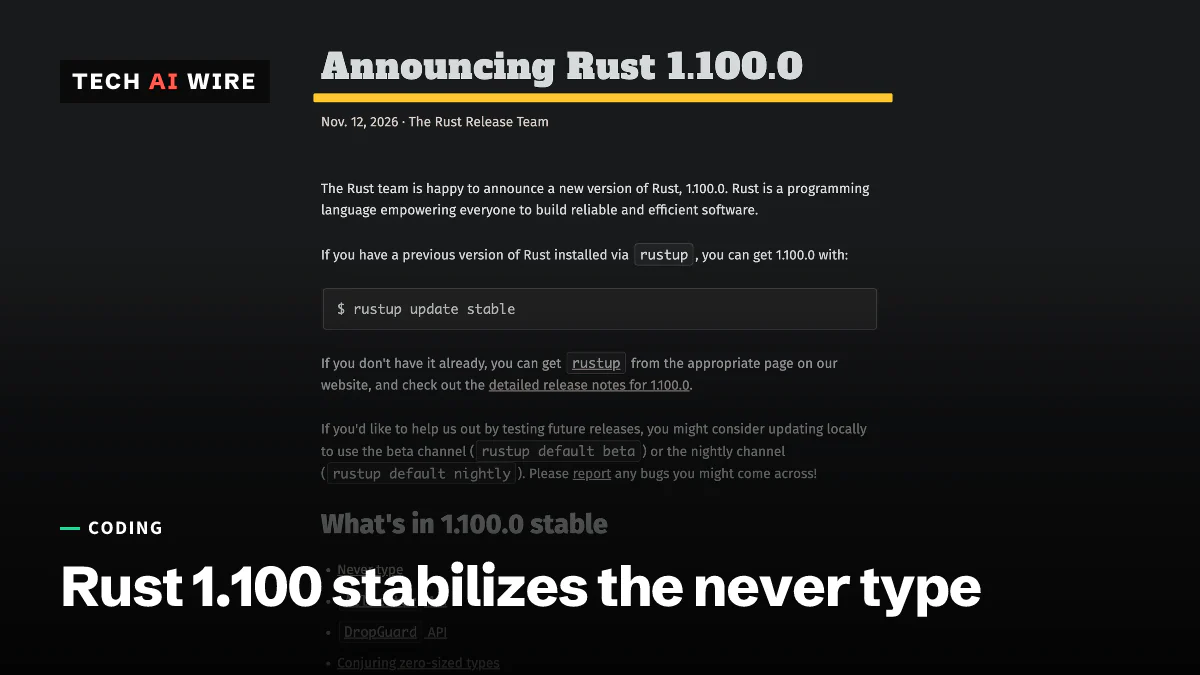
The Rust project released Rust 1.100.0 on November 12, 2026. It makes the never type stable, opens the core of the custom allocator API, and teaches Cargo to warn about unused dependencies. The never type change is also a breaking change, and the release notes list it under "Compatibility Notes". Projects on any edition can now fail to build where they compiled before.
The Rust Blog announcement says the never type took 10 years and 5 failed attempts to reach stable. LWN.net led with the same three changes: the never type, the core of the Allocator API, and Cargo's unused-dependency report. Rust users update with rustup update stable.
What is new in Rust 1.100
The never type, written !, is the type of code that never finishes, such as a panic! or an endless loop. Until now it could only appear as a function's return type. Our guide to Rust's never type explains it in full, and our August story covered the pull request that made it stable.
The table below is built from the blog post, the release notes on GitHub and the Cargo changelog.
| Change | What it does | Who notices |
|---|---|---|
Never type ! | Usable anywhere, as in Result<T, !>; Infallible becomes an alias for ! | Code that leaned on the old fallback |
| Type fallback | An unknown type in a diverging branch now becomes !, not (), on all editions | Older crates that never moved to edition 2024 |
| Allocator API | Allocator, Global, System, and Vec::new_in, Box::new_in and similar methods | Code that manages its own memory |
cargo::unused_dependencies | Warns when a dependency in Cargo.toml is never used | Every Cargo project |
| Minimum publish age | Cargo can skip crate versions newer than a set age | Teams worried about supply-chain attacks |
| Build directory layout | Intermediate build files move | Scripts that read Cargo's target folder directly |
i686-pc-windows-gnu | Now Tier 2 without host tools | 32-bit Windows users |
The 32-bit Windows change was announced in October, as our story on the i686 targets explains. The release also stabilizes smaller helpers, such as bool::toggle, Vec::from_fn and str::trim_prefix.
Tech AI Wire test: Rust 1.99.1 against 1.100.0
In a Tech AI Wire test on macOS 26.6.2, the same small projects ran in the official rust:1.99-slim and rust:1.100-slim Docker images. Both are Debian 13 on arm64. The images reported rustc 1.99.1 and rustc 1.100.0.
The first project used edition 2021 and this code:
fn make<T: Default>() -> Result<T, ()> {
    Ok(T::default())
}

fn main() -> Result<(), ()> {
    make()?;
    Ok(())
}
Nothing tells the compiler what T is, so it falls back to a default type. Here is what each version did:
| Code | Rust 1.99.1 | Rust 1.100.0 |
|---|---|---|
| As written | Error from the lint dependency_on_unit_never_type_fallback | Error E0277: "the trait bound !: Default is not satisfied" |
With #![allow(dependency_on_unit_never_type_fallback)] | Builds and runs | Still error E0277; the lint "has been removed" |
With make::<()>()? | Builds and runs | Builds and runs |
The middle row is the trap. A crate that silenced the warning on 1.99 builds there, then fails on 1.100. Rust 1.100 says the lint was removed because "the code warned by this lint no longer compiles". Only naming the type fixes it.
The custom allocator test wrapped the global allocator to count requests. On 1.99.1 it failed with error E0658, "use of unstable library feature allocator_api". On 1.100.0 it ran on stable. A Vec of 1,000 numbers plus one Box made 10 allocation calls for 16,356 bytes.
Tech AI Wire test: Cargo's two new safety checks
A crate (a Rust package) listed itoa and memchr as dependencies but used only itoa. On 1.100, cargo build printed "warning: unused dependency memchr". Setting unused_dependencies = "deny" under [lints.cargo] turned it into an error, and the build stopped. A dev-dependency that was never used got no warning. Neither did cargo check --bin unused, which checks a single target. Both match exemptions the blog post lists. Rust 1.99.1 ignored the [lints.cargo] table with an "unused manifest key" warning.
The minimum publish age delays brand-new crate versions, which the blog post calls "dependency cooldowns". The wait gives others time to spot a bad release before your build pulls it in. With global-min-publish-age = "3 days" set under [registry], Cargo locked cc at 1.11.1. It printed "available: v1.11.2, published 2 hours ago". With the setting removed, Cargo picked 1.11.2. With 30 days, resolution failed, because cargo add had already written 1.11.1 as the minimum version. Cargo suggested lowering the requirement to "1.8.0" or setting CARGO_RESOLVER_INCOMPATIBLE_PUBLISH_AGE=allow.
What this means for developers
- Build every crate on 1.100 before you upgrade CI. Older-edition code is the most likely to break. Search for
allow(dependency_on_unit_never_type_fallback), because that code fails on 1.100. - Fix fallback errors by naming the type. The compiler's own suggestion, such as
make::<()>(), worked on both versions in the test. - Turn on the publish age now. Three days of
global-min-publish-agein.cargo/config.tomlcosts little. Set it before runningcargo add, since that command writes the version it picks intoCargo.toml. - Clean up unused dependencies before you deny them. Start at the default
warn, remove what it finds, then switch todenyin CI. - Read the Compatibility Notes. They also list removed
boxpatterns, Unicode 18.0.0 and stricter ARM target-feature checks. - Stop reading Cargo's build folders directly. Their layout changed in 1.100, and the Cargo changelog says tools should use Cargo's JSON messages instead.
Sources
- Announcing Rust 1.100.0 - Rust Blog
- Rust 1.100.0 release notes - GitHub - rust-lang/rust
- Cargo changelog: Cargo 1.100 - The Cargo Book
- Rust 1.100.0 released - LWN.net
Related articles
Rust 1.99.1 fixes FFI bool miscompile and two link bugs
Rust 1.99.1 fixes three regressions from 1.99.0, including x86_64 FFI functions that could return bool values other than 0 or 1. Update with rustup.
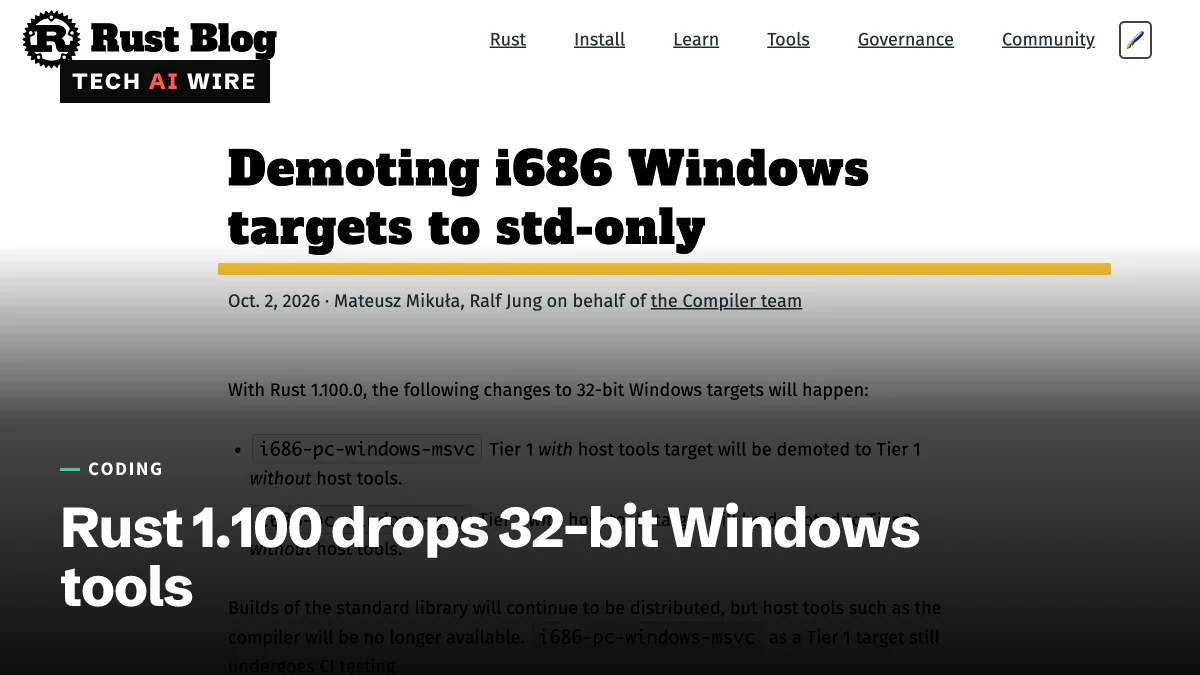
Rust 1.100 drops host tools for 32-bit Windows targets
Rust 1.100 stops shipping the compiler for 32-bit Windows. The i686 targets keep the standard library, so cross-compiling from 64-bit Windows still works.
Rust 1.99 stabilizes C-variadic function definitions
Rust 1.99.0, out October 1, 2026, lets stable Rust define C-variadic functions like printf, moves to LLVM 23 and makes no_mangle on generics an error.
The weekly digest
One email every Friday with the week's top stories from all six desks: AI, dev tools, coding, the tech industry, startups and what's next. Free, no spam.