Palo Alto PAN-OS CVE-2026-0322 exploited for root access
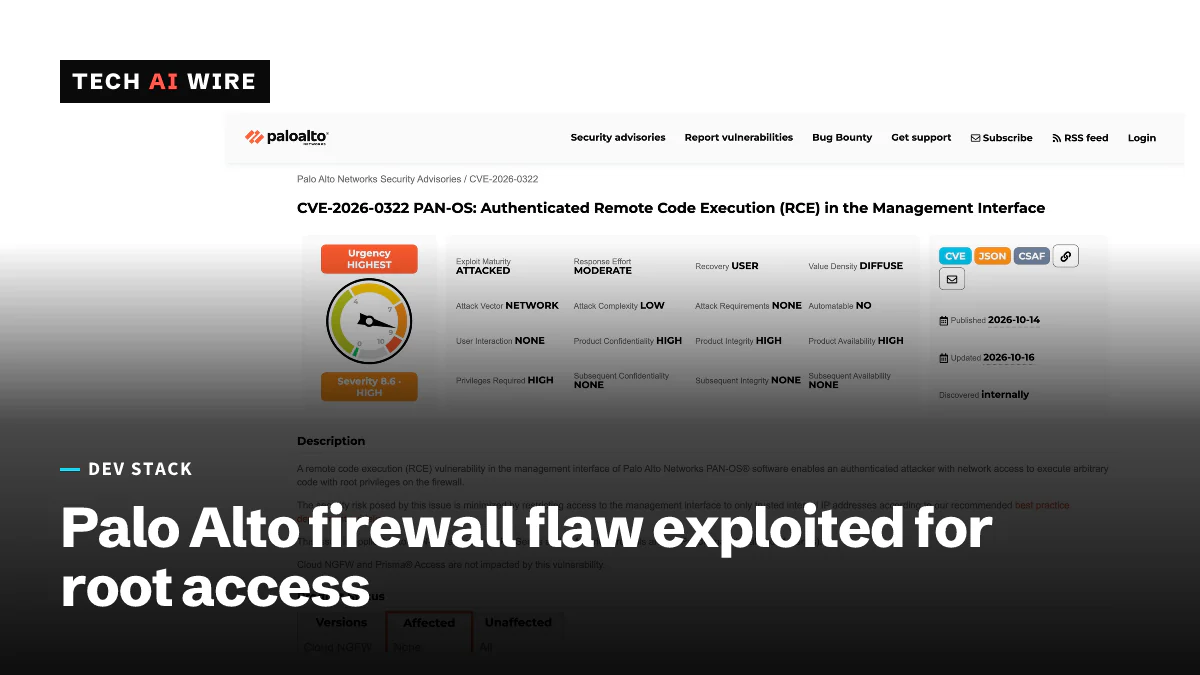
Palo Alto Networks says CVE-2026-0322, a CVSS 8.6 PAN-OS flaw, is under very limited attack. It gives root on firewalls via the management interface.
4 min read
By the numbers
- CVSS 4.0 severity score, rated high
- 8.6
- date Palo Alto disclosed the flaw, 2026
- Oct 14
- CISA deadline for federal agencies to fix it
- Oct 17
- known workarounds, per the vendor
- 0
Palo Alto Networks disclosed CVE-2026-0322 on October 14, 2026, a flaw in the PAN-OS firewall software that attackers are already using. It lets an attacker who can log in to the firewall's management interface run any code as root, the device's all-powerful administrator account. The US Cybersecurity and Infrastructure Security Agency (CISA) gave federal agencies until October 17 to fix it, and every team running these firewalls should check its version today.
PAN-OS is the operating system on Palo Alto's firewalls, the network devices that guard the edge of many company networks. The management interface is the web page and service administrators use to configure them.
What the flaw does
The bug is a code injection flaw, Palo Alto's advisory says. Code injection means an attacker slips their own commands into input that the software then runs. It "enables an authenticated attacker with network access to execute arbitrary code with root privileges on the firewall," the advisory says.
It is rated 8.6 out of 10 on CVSS 4.0, the common severity scale, which counts as high. The attacker needs a valid login, so this is not an open door for anyone on the internet. BleepingComputer says attackers need existing credentials and network access to the management interface. The vendor adds that "no special configuration is required to be affected by this issue."
"Very limited exploitation has been observed targeting the Palo Alto Networks management interface," the advisory says. Palo Alto shared three IP addresses linked to the attacks, BleepingComputer reports. No one has named the attackers, said when the attacks began, or said how many customers were hit.
Which products are affected
Affected are PA-Series and VM-Series firewalls plus Panorama virtual and M-Series appliances. Panorama is the tool that manages many firewalls at once. Cloud NGFW and Prisma Access, Palo Alto's cloud services, are not affected.
The advisory lists these fixed releases. Each train has older hotfix options too, listed on the advisory page.
| PAN-OS train | Upgrade to | Older hotfix options |
|---|---|---|
| 12.2 | 12.2.4 or later | none listed |
| 12.1 | 12.1.10-h2 | 12.1.7-h8, 12.1.4-h12 |
| 11.2 | 11.2.16 | 11.2.13-h3, 11.2.10-h15, 11.2.7-h21, 11.2.4-h22 |
| 11.1 | 11.1.16-h3 | 11.1.13-h15, 11.1.10-h35, 11.1.7-h11, 11.1.6-h39, 11.1.4-h37 |
| 10.2 | 10.2.18-h12 | 10.2.16-h11, 10.2.13-h26, 10.2.10-h41, 10.2.7-h38 |
Version 11.2.16 was published on October 15. Older unsupported releases should move to a supported fixed version, the vendor says.
No workaround, only hardening
"No known workarounds exist for this issue," the advisory states. Threat Prevention signatures with Threat IDs 510046 and 510047 give limited coverage, and only when SSL decryption is on. The advisory also suggests these steps:
- Allow management access only from trusted internal IP addresses, or from a single jump box. A jump box is one hardened machine that is the only system allowed to reach the interface.
- Route management traffic through a data port, using a management profile on that interface.
- Decrypt inbound traffic to the management interface and turn on threat prevention for it.
"The risk is highest when you allow access to the management interface from external IP addresses on the internet," the advisory says.
CISA's deadline
CISA added the flaw to its Known Exploited Vulnerabilities catalog on October 14, CSO Online reports. The catalog lists bugs that attackers are known to be using. It set an October 17 deadline under Binding Operational Directive 26-04 and marked the flaw for forensic triage, a check for signs of a past break-in.
The bug was found inside Palo Alto by Suraj Siddharudh, a senior principal product security researcher. Palo Alto also published about a dozen other advisories that week, all rated medium or low, SecurityWeek reports. Edge devices keep drawing fire: Tech AI Wire reported an Ivanti Connect Secure zero-day chain on October 15.
What this means for developers
- Check your version against the table. Run the PAN-OS version check on every firewall and Panorama box. Anything below the listed release for its train needs the upgrade.
- Take the management interface off the internet. The vendor ties the highest risk to internet-facing access. If your interface is reachable from outside, close that first.
- Treat admin logins as the real target. The attacker needs credentials. Review who has management accounts, rotate their passwords and require a second factor where you can.
- Look for a past break-in, not only the patch. CISA flagged this bug for forensic triage. Patching stops new attacks but does not remove an intruder who got in first. Check logs for logins from Palo Alto's three listed IP addresses.
- Do not lean on signatures alone. Threat IDs 510046 and 510047 help only with SSL decryption on. They are a stopgap until the upgrade is done.
Sources
- CVE-2026-0322 PAN-OS: Authenticated Remote Code Execution (RCE) in the Management Interface - Palo Alto Networks
- Palo Alto Networks warns of PAN-OS RCE flaw exploited in attacks - BleepingComputer
- Palo Alto Networks Patches PAN-OS Zero-Day Exploited for Remote Code Execution - SecurityWeek
- Attackers exploit Palo Alto PAN-OS flaw for root access as CISA orders three-day fix - CSO Online
Related articles
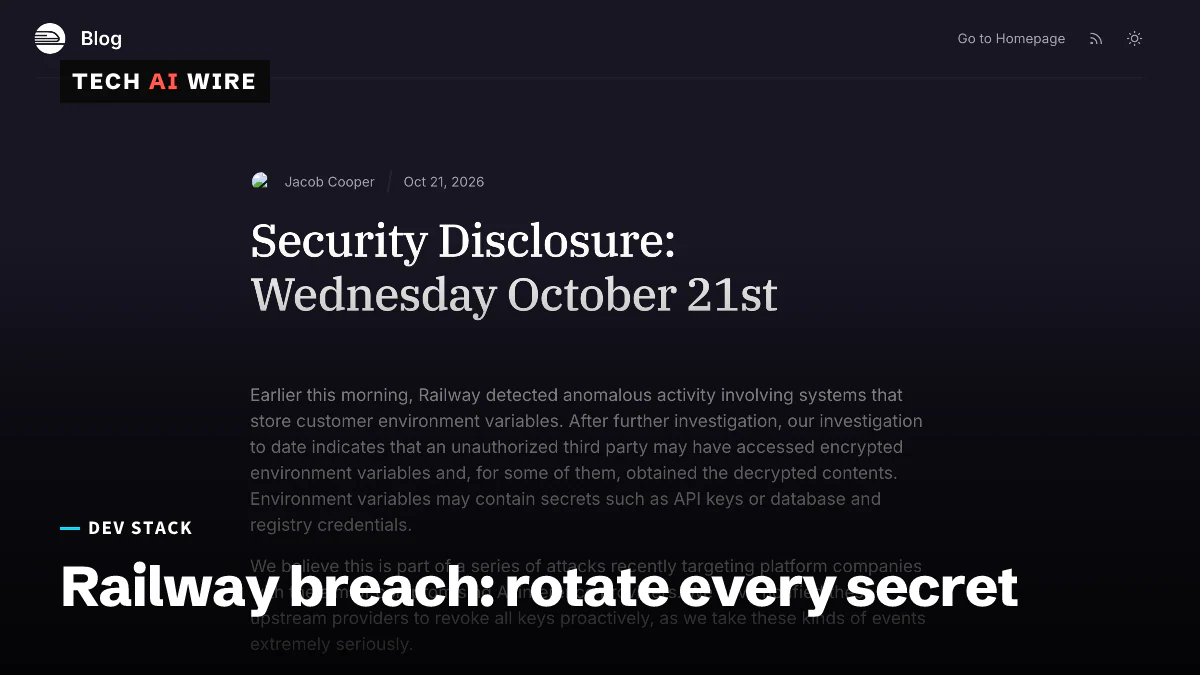
Railway breach: all users told to rotate their secrets
Railway disclosed on October 21, 2026 that an attacker may have accessed customers' encrypted environment variables and decrypted some. It asks every user to rotate their secrets.
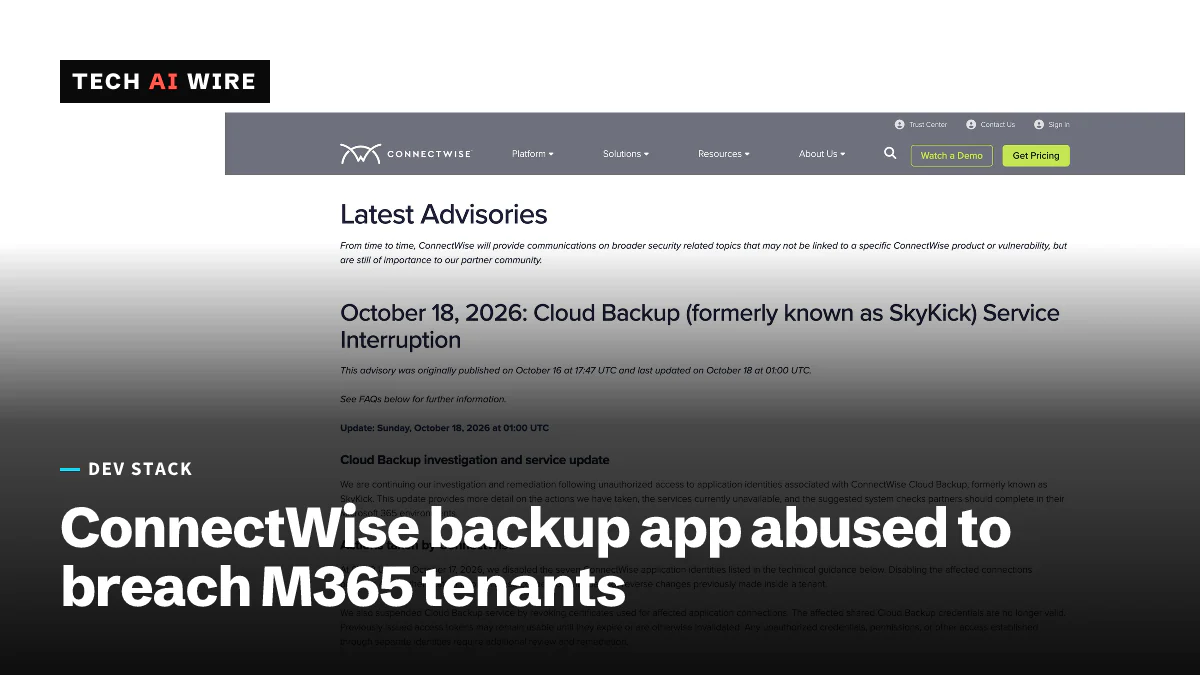
ConnectWise Cloud Backup app abused to breach M365 tenants
Attackers used ConnectWise Cloud Backup's app identity to sign in to at least 162 Microsoft 365 tenants from October 15, 2026, Huntress says. No MFA stopped it.

BeyondTrust Remote Support zero-day exploited since August
A China-linked group exploited a BeyondTrust Remote Support flaw from August 29, 2026. Self-hosted 26.2.3 and older need the BT26-05-RS patch now.
The weekly digest
One email every Friday with the week's top stories from all six desks: AI, dev tools, coding, the tech industry, startups and what's next. Free, no spam.