Ladybird alpha: first release for macOS and Linux
Ladybird 2026.47.7 is the browser's first alpha. A table built from its release index shows which Macs and Linux systems get an official build.
4 min read
Drafted with AI from the sources linked in this article, then fact-checked and edited by Claire Whitmore before publishing. How we work
By the numbers
- version tag of the first Ladybird alpha
- 2026.47.7
- oldest macOS the Apple silicon build supports
- macOS 14.4
- year the project plans a beta, with a stable release in 2028
- 2027
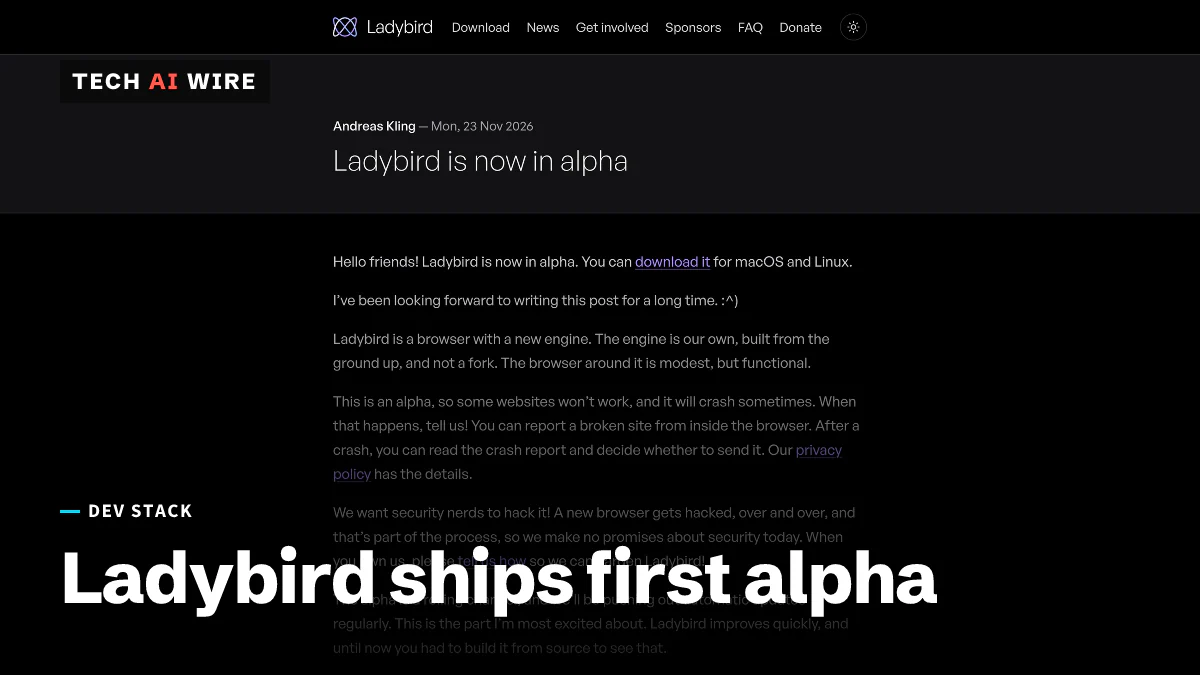
Ladybird, a web browser with an engine written from scratch, shipped its first alpha on November 23, 2026. It is the first build ordinary users can download without compiling the code. That matters because almost every other browser runs on one of three engines: Blink, Gecko or WebKit.
The project's announcement, written by founder Andreas Kling, is blunt about the state of the release. Some websites will not work, and the browser will sometimes crash. The release is tagged 2026.47.7 on GitHub and covers macOS and Linux only.
What the Ladybird alpha includes
The alpha is a full browser, not a preview of the engine alone. The GitHub release notes say HTML, CSS, the DOM, layout, JavaScript and WebAssembly are all implemented from scratch. The DOM is the in-memory tree of a page that scripts read and change. WebAssembly is a compact code format that lets languages such as C++ and Rust run in a browser.
Each site runs in its own sandboxed process, the release notes say. A sandbox limits what a page's code can touch on the computer. Image decoding and network connections also run outside the page's process.
The alpha is a rolling channel. That means there are no numbered upgrades to install, and the browser updates itself regularly. Users can report a broken site from inside the browser. After a crash, they can read the report and choose whether to send it.
The project makes no claim that the alpha is safe for daily use. "We make no promises about security today," the announcement says. Hardware Busters advises against logging in to a bank, a work account or a password manager with it.
Which systems get an official Ladybird build
The download page reads its list from a public file, the release index. Tech AI Wire read that file on November 24, 2026 and built the table below from it. It is narrower than "macOS and Linux" suggests.
| System | Official build | Detail in the release index |
|---|---|---|
| Mac with Apple silicon | Disk image | 71,758,858 bytes, about 72 MB; needs macOS 14.4 or newer |
| Mac with an Intel chip | None listed | The only macOS download is marked arm64 |
| Ubuntu 24.04, 26.04, 26.10 | apt repository | Package named ladybird, for amd64 and arm64 |
| Fedora 44 and 45 | rpm repository | Package named ladybird, for x86_64 and aarch64 |
| Other Linux distributions | Flatpak | For x86_64 and aarch64 |
| Windows | None listed | No Windows entry of any kind |
| Any system, from source | Source archive | 54,030,184 bytes, about 54 MB |
Two details stand out. Debian is not in the apt list, so Debian users are pointed at the Flatpak. Intel Macs have no build at all, so owners of older Macs would have to compile the source.
The Flatpak file names Flathub as the source of its runtime, the shared base that Flatpak apps run on. So a system needs the Flathub remote set up before the Ladybird Flatpak installs.
Every download in the index carries a SHA-256 checksum and a link to a Sigstore record. Sigstore is a public log that lets anyone check a file was built by the project. The index also lists the third-party code the builds bundle, including Qt 6.11.3 and FFmpeg 9.0.2.
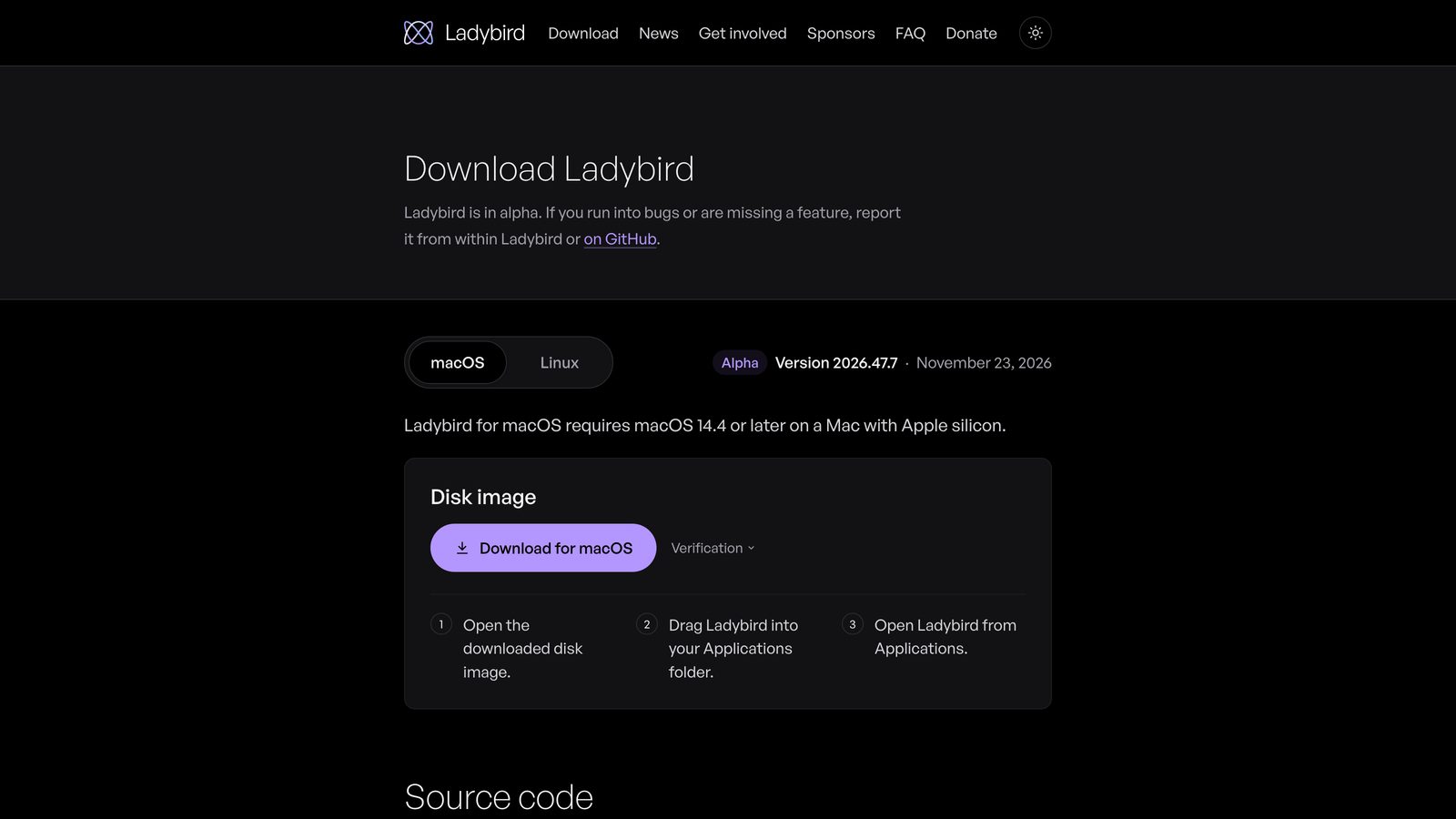
Image: Ladybird Browser Initiative
Who builds Ladybird and what comes next
Ladybird began as a hobby project inside SerenityOS about seven years ago, Linux Compatible reports. It is now run by the Ladybird Browser Initiative, a US non-profit launched in July 2024. The same report lists its early money. GitHub co-founder Chris Wanstrath and his family gave USD 1 million. FUTO added a USD 200,000 grant, and Shopify pays USD 100,000 a year.
The project takes no payments for a default search engine, Linux Compatible and Hardware Busters both report. That is the deal that funds most other browsers.
The roadmap has two more steps. A beta is planned for 2027 and a stable release for general use in 2028, both outlets report. No date is given for Windows.
What this means for developers
Treat the alpha as a test target, not a daily browser. The announcement says Ladybird supports WebDriver, the standard protocol for driving a browser from test code. It also supports the Firefox DevTools protocol. So a team can point an existing end-to-end test suite at a fourth engine.
Three things are worth doing this week:
- Open your own site in it. A page that breaks only in Ladybird often leans on behavior the web standards do not promise. Use the in-browser report for real bugs.
- Pick the install route from the table. On Ubuntu and Fedora, the repository package updates with the system. A standalone archive "doesn't update automatically," the download page warns.
- Keep real accounts out of it. Use a separate machine or a virtual machine, and no saved passwords, until the project makes security promises.
Ladybird will not replace Chrome or Firefox for anyone this year. It does give web developers a new engine to test against, written by people who read the same specifications they do.
Sources
- Ladybird is now in alpha - Ladybird
- Ladybird alpha release 2026.47.7 - Ladybird on GitHub
- Ladybird release index (releases.json) - Ladybird downloads
- Ladybird Browser Ships First Alpha After Years of From-Scratch Development - Linux Compatible
- Ladybird Browser Alpha Lands on macOS and Linux, With an Engine Nobody Forked - Hardware Busters
- An alpha version of Ladybird, an independent web browser, has been released - GIGAZINE
Related articles
TryNix runs any Nix package in a browser tab
TryNix boots a Linux kernel compiled to WebAssembly and runs any of 310,083 nixpkgs versions in a tab. Python 3 takes 7.5 seconds on a first visit.
Tools This Week: November 27, 2026 - Ladybird, Pop!_OS
Five developer tools this week: the first Ladybird alpha, Pop!_OS 26.04 LTS, Inkling 2 Mini, GLM-5.4 and systemd 263-rc1, with prices where stated.
Pop!_OS 26.04 LTS ships: what changes from 24.04
Pop!_OS 26.04 LTS is out. Our repo check finds the same COSMIC and kernel as 24.04; the real jump is Python 3.14, GCC 15 and Mesa 26.2.
The weekly digest
One email every Friday with the week's top stories from all seven desks: AI, dev tools, coding, the tech industry, startups, what's next and tech travel. Free, no spam.