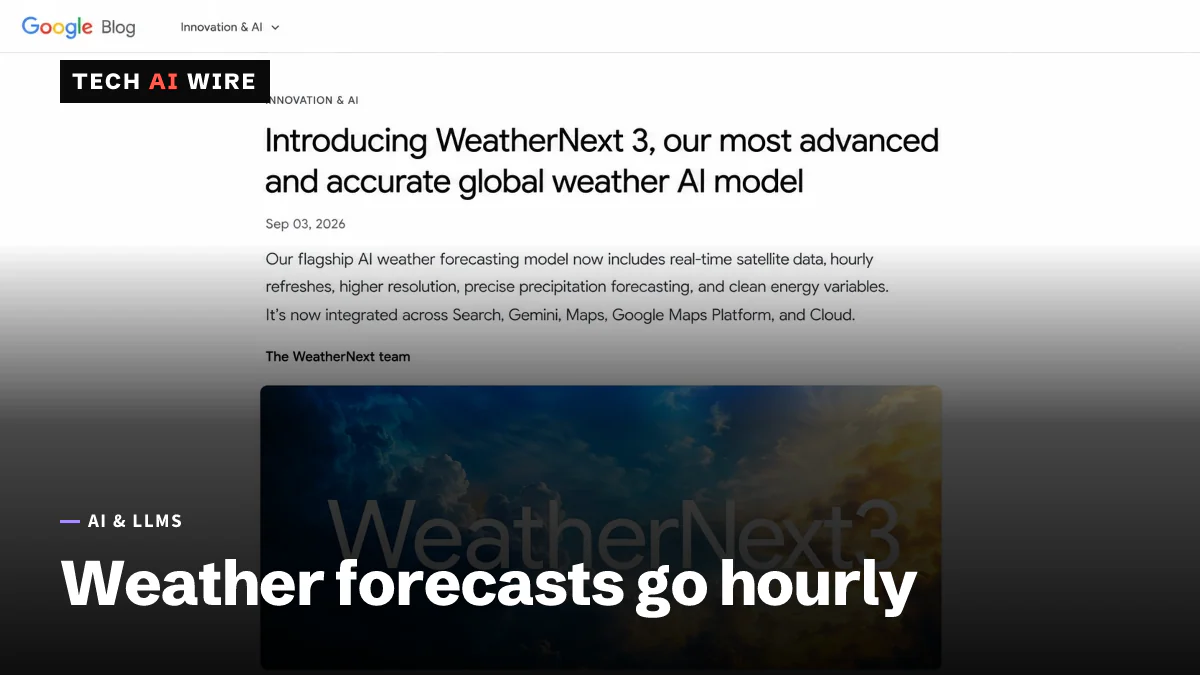
Google's WeatherNext 3 brings hourly, 5km weather forecasts
Google DeepMind's WeatherNext 3 forecasts hourly at up to 5km resolution, replacing 6-hour updates. Developers can query it via BigQuery, Earth Engine, or bulk Cloud Storage downloads.
3 min read
By the numbers
- resolution for temperature and moisture, versus 25km before
- 5km
- new forecast cadence, versus every 6 hours in WeatherNext 2
- hourly
- rain-forecast improvement Google reports against satellite data
- 60%
- Temperature and moisture
- 5km
- Other surface variables
- 10km
- Wind speed and atmosphere
- 25km
Google DeepMind released WeatherNext 3 on September 3, 2026, a weather forecasting model that updates its predictions every hour instead of every six. The new version also sharpens resolution for key variables down to 5 kilometers, replacing the flat 25-kilometer grid its predecessor used for everything.
What actually improved
The old model, WeatherNext 2, produced one resolution for every kind of data: 25 kilometers, refreshed every six hours. WeatherNext 3 splits that apart by variable.
| Variable type | Resolution |
|---|---|
| Temperature and moisture | 5 kilometers |
| Other surface variables | 10 kilometers |
| Wind speed and atmospheric variables | 25 kilometers |
Google's own announcement and Unite.AI both describe the update as roughly five times sharper for the variables people check day to day. Forecasts now arrive every hour rather than every six.
What actually feeds the model
The jump in detail traces back to what the model reads, not just how it was trained.
Unite.AI reports the model ingests an 11-channel geostationary satellite mosaic at 0.1-degree resolution, updated continuously. It also draws on ground observations from weather stations, NASA's precipitation data, and a custom global precipitation reanalysis dataset. That live satellite feed is what makes hourly updates possible. Each forecast is grounded in observations from within the last hour, rather than waiting for the next scheduled run.
Both sources report a real accuracy gain from this approach, not just more frequent output. Rain forecasts improved by up to 60% measured against NASA's satellite precipitation product, and by 30% against ground radar.
Where developers can actually reach it
This is a model built to be queried, not just read about.
Google's announcement lists direct access through BigQuery and Earth Engine, plus bulk downloads from Google Cloud Storage. The download format is Zarr, a chunked array format built for large gridded scientific data. The same model also powers weather results inside Search, Gemini, Google Maps, and the Google Maps Platform Weather API.
Unite.AI notes one explicit limit worth repeating rather than glossing over. Google itself describes WeatherNext as "an automated, experimental AI system," and says users should consult official meteorological agencies for severe weather rather than relying on it alone.
What this means for developers
If you already pull weather data through the Maps Platform Weather API or Earth Engine, check one thing first. Confirm whether your integration is pinned to a specific model version, before this change rolls out under you silently. A jump from 6-hour to hourly updates changes the shape of the data your code receives, not just its accuracy. A caching layer built around 6-hour freshness assumptions will now serve stale data far more often than it used to.
Budget differently for the raw access path. Bulk-downloading gridded Zarr data from Cloud Storage has a different cost and engineering profile than querying BigQuery for the exact cells you need. If your use case only touches a handful of locations, query rather than download. If you need the full grid for offline modeling, the bulk path is built for exactly that.
Keep the "experimental" label in your own risk assessment, not just Google's. A model good enough to power Search's weather answers is still explicitly flagged as unsuitable as your only source for severe-weather decisions. If your product makes any safety-relevant call based on this data, keep an official meteorological source as the fallback, not an afterthought.
Sources
Related articles

OpenAI GPT-6 models come to Google Cloud in preview
Google Cloud began a private preview of OpenAI's GPT-6 Astra, GPT-6.1 Sol and GPT-6 Luna on October 21, 2026, billed through its Marketplace.
Gemini 4 Argon is now generally available at $2/$10
Google made Gemini 4 Argon generally available on October 13 at $2 per million input tokens and $10 output, a price that doubles on December 1.
Gemini's free tier drops to Flash-Lite only on October 9
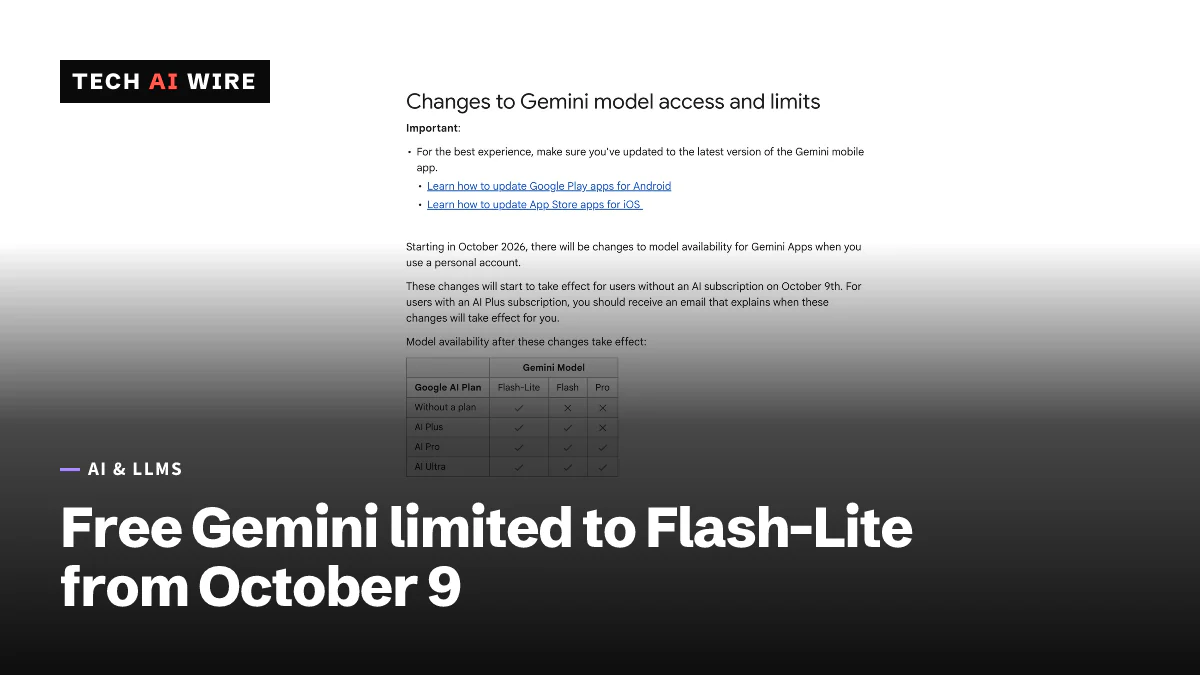
From October 9, free Gemini app users can only use Flash-Lite. AI Plus, at $4.99 a month, loses Pro on a date Google emails to each subscriber.
The weekly digest
One email every Friday with the week's top stories from all six desks: AI, dev tools, coding, the tech industry, startups and what's next. Free, no spam.