Google DeepMind Genie 4 adds native audio to world model
Google DeepMind's Genie 4, announced October 27, builds interactive worlds with native audio. Trusted testers have it; Gemini API partners are next.
3 min read
Drafted with AI from the sources linked in this article, then fact-checked and edited by Claire Whitmore before publishing. How we work
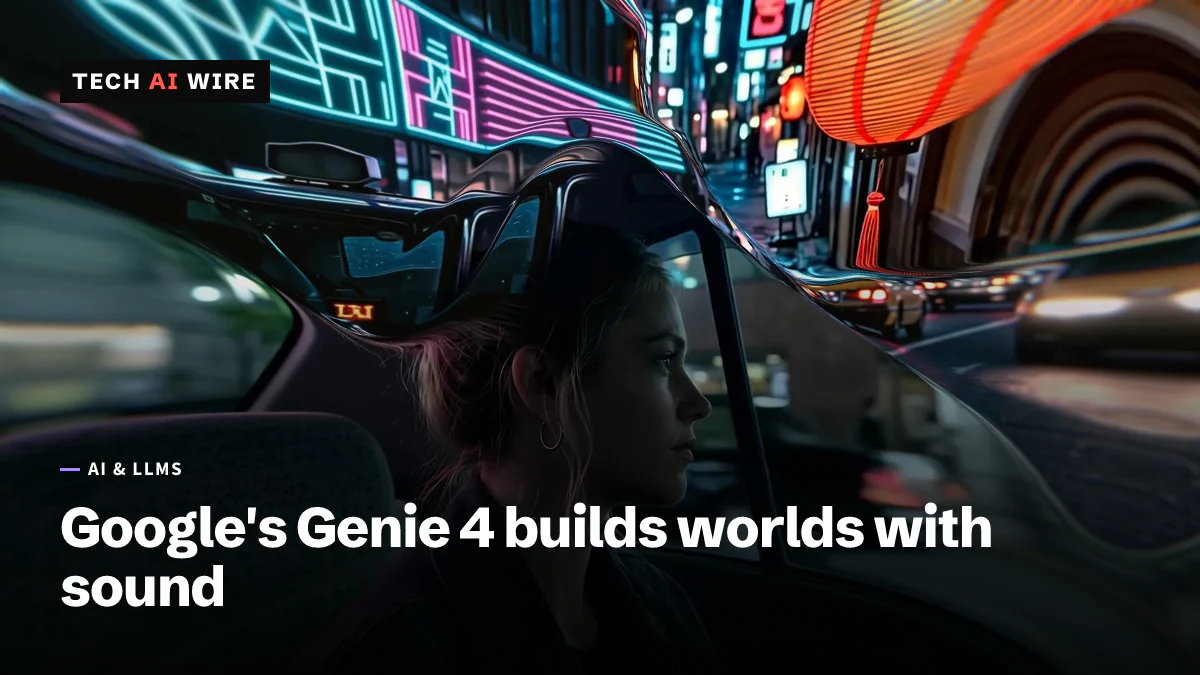
Google DeepMind announced Genie 4 on October 27, 2026, a world model that generates interactive scenes with sound built in. A world model is an AI system that creates a place you can move through and change in real time, like a game level made on the fly. Google's announcement says every world now "generates native audio on the fly, including ambient sounds, music, and interactive dialogue." A small group of trusted testers has it now, and developers are next in line through the Gemini API.
Google frames the work as more than entertainment. "Simulating the world is a crucial step toward AGI, enabling safe training environments for robots and agents," its blog post says.
What Genie 4 adds
Users steer a scene with plain-language instructions while it runs. Google's examples include moving the camera, changing the weather and adding characters.
The Google DeepMind model page calls Genie 4 "our most realistic and interactive world model yet." It says Gemini Omni anchors how things look and behave. Other Gemini models handle the reasoning that keeps a scene coherent over time.
Gizmodo compares it with Genie 3, which Google unveiled in August last year. Genie 3 had no audio, and its people "tended to be more mechanical," the outlet writes. Genie 4 shows smoother human motion and facial expressions, with characters that talk and react. Gizmodo's headline says the model generates human voices. Google's own pages describe "interactive dialogue" but do not use the word voice.
Who can use it, and when
| Group | Access |
|---|---|
| Trusted testers | Rolling out now as a research preview |
| Google AI Ultra subscribers | "Coming soon" in Project Genie |
| Gemini API early-access partners | "Coming soon" |
| Google AI Studio early-access partners | "Coming soon" |
| Everyone else | A waitlist on the DeepMind page |
Google has not given a price or a date for wider release. Gizmodo reports the current testers include video game developers.
Project Genie is Google's web app for exploring generated worlds. Gizmodo notes that its launch in January reportedly sent video game stocks sharply lower.
Safety and watermarks
Google DeepMind says it released Genie 4 to trusted testers first on purpose. The model has "strict safety guardrails that are consistent with our safety policies across other models," the model page says.
Every video and audio clip Genie 4 makes will carry SynthID, Google's invisible watermark for spotting AI-generated content. That covers both picture and sound.
What Google says it cannot do yet
The model page has a frank list of limits:
- It supports "a few minutes of continuous interaction, rather than extended sessions."
- It cannot simulate real-world locations with perfect accuracy.
- Real-time audio accuracy is still being improved.
- Visual details and object permanence can drift over time, especially after several complex prompt edits.
- Interactions between many independent agents in a shared world remain hard.
- Legible text usually appears only when the input describes it.
Gizmodo adds that the model "occasionally struggles to maintain visual consistency and audio accuracy."
What this means for developers
Genie 4 is not something most developers can call today. The steps worth taking now are about preparation.
- Join the waitlist if you build games or simulations. Early-access Gemini API partners will shape how the model is exposed. Getting in early gives you a say.
- Design for short sessions. A few minutes of interaction suits prototypes, demos and level ideas. It does not yet suit long play sessions or persistent worlds.
- Treat it as a robot training ground, carefully. Google is exploring robotics uses. Worlds that drift over time can teach agents the wrong lessons, so check results against real-world tests.
- Plan for watermark checks. All output carries SynthID. If your product mixes real and generated footage, decide how you will label it and detect it.
- Hold your budget. There is no published price yet. Avoid building a business case until rates and rate limits are public.
- Watch the audio. Sound is the headline feature and also a listed weak spot. Test whether dialogue stays in sync before you rely on it for really interactive characters.
Genie 4 moves world models from silent clips toward scenes with sound and speech. The few-minute limit and the drift problems show how far they still are from replacing a game engine.
Sources
Related articles
Gemini 4 Argon is now generally available at $2/$10
Google made Gemini 4 Argon generally available on October 13 at $2 per million input tokens and $10 output, a price that doubles on December 1.
Nano Banana 2.1 halves the price of Gemini images
Google's Nano Banana 2.1 image model costs $0.0336 per 1K image in the Gemini API, half the price of Nano Banana 2, which Google has now deprecated.

Vulkan 1.4.366 adds SMPTE ST 2094-50 dynamic HDR metadata
Vulkan 1.4.366, dated October 23, adds a Google extension that attaches SMPTE ST 2094-50 dynamic HDR metadata to a swapchain, plus 16 spec fixes.
The weekly digest
One email every Friday with the week's top stories from all six desks: AI, dev tools, coding, the tech industry, startups and what's next. Free, no spam.