Go 1.27 adds generic methods and a faster encoding/json
Go 1.27 shipped on August 19, 2026 with generic methods, a v2 engine under encoding/json, goroutine leak profiles and post-quantum signatures.
4 min read
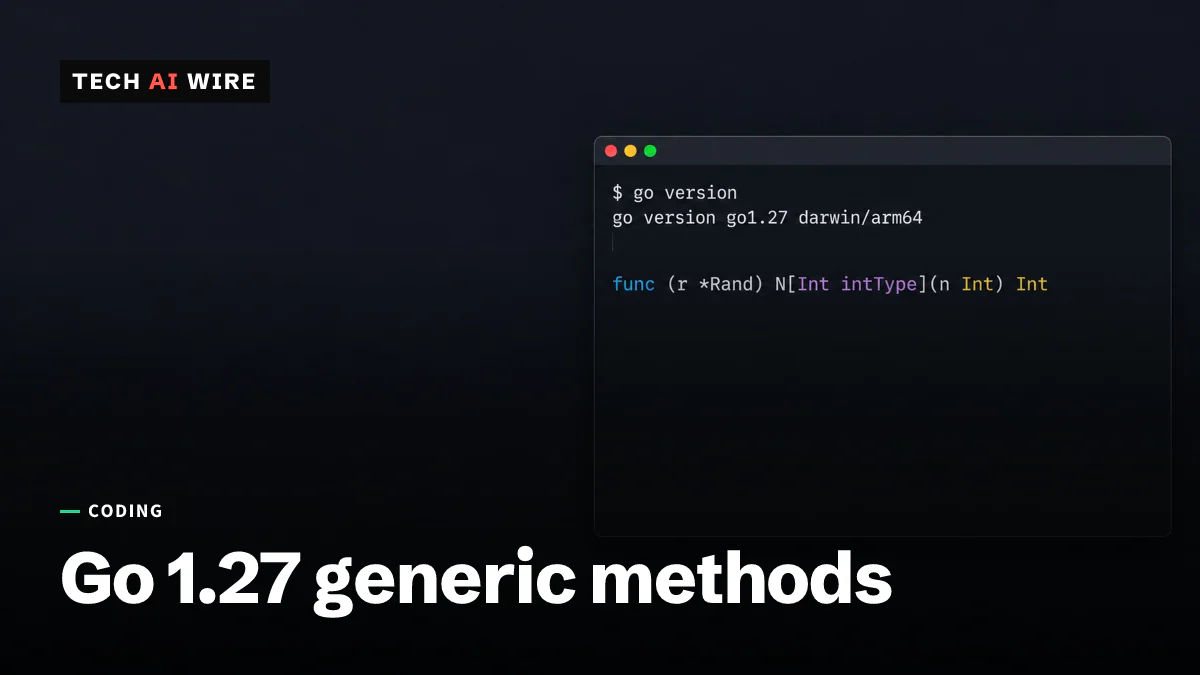
Go 1.27 was released on August 19, 2026, and it changes the language itself. Methods can now declare their own type parameters, which Go has refused since generics arrived. Nicholas Husin announced the release on the Go blog for the Go team.
Two other changes will reach more programs than the language work does. The standard JSON package now runs on a new engine, and the runtime can tell you which goroutines have leaked.
Generic methods, and their one limit
Before this release, a type could be generic but its methods could not add type parameters of their own. Authors wrote one method per concrete type instead.
The release notes point at math/rand/v2.Rand as the example. Its method now reads (*Rand) N[Int intType](Int) Int. One method covers every integer type.
There is a firm restriction. Interface methods may not declare type parameters, so a generic method cannot implement an interface method. That boundary is deliberate and it is not a temporary gap.
Two smaller language changes ship alongside it. A key in a struct literal "may now be any valid field selector for the struct type," which lets you set nested and embedded fields directly. And function type inference "has been generalized to apply in all assignment contexts", including composite literals, conversions and channel sends.
encoding/json now runs on v2
The encoding/json package is now backed by a v2 implementation. The v1 API stays, and the release notes are explicit that it is not deprecated. No migration is required.
The defaults did get stricter, and this is where working code can break. The v2 engine rejects invalid UTF-8 inside JSON strings. It also rejects duplicate names in a JSON object. Both used to pass.
| Change | Effect |
|---|---|
| Invalid UTF-8 in strings | Now rejected |
| Duplicate object keys | Now rejected |
| Unmarshal speed | Significantly faster |
| Marshal speed | About the same |
format and unknown tags | Removed in v2 |
inline tag option | Renamed to embed |
If something breaks, GOEXPERIMENT=nojsonv2 restores the old implementation at build time. Treat that as a deadline, not a fix. The release notes say the opt-out is expected to be removed in a future release.
Two new packages come with it: encoding/json/v2, which takes variadic options, and encoding/json/jsontext for working at the token level.
Leak profiles, allocation and post-quantum signatures
The goroutine leak profile is now generally available in runtime/pprof, after being experimental in Go 1.26. A leaked goroutine is "a goroutine blocked on some concurrency primitive (channels, sync.Mutex, sync.Cond, etc) that cannot possibly become unblocked".
The runtime finds them using the garbage collector. If a blocked goroutine waits on something no runnable goroutine can still reach, it can never wake. Read it at /debug/pprof/goroutineleak. It has a stated blind spot: leaks on primitives reachable through global variables can be missed.
Allocation got cheaper. The compiler now calls size-specialized allocation routines, cutting the cost of allocations under 80 bytes by up to 30%. The release notes put the whole-program gain at roughly 1% for allocation-heavy code, and the binary grows by about 60 KB.
For security teams, crypto/mldsa implements ML-DSA, the post-quantum signature scheme in FIPS 204. TLS 1.3 gains the MLDSA44, MLDSA65 and MLDSA87 signature schemes, and x509 handles the keys.
What this means for developers
Read the removals before you upgrade, because that is where the breakage is. Go 1.27 now requires macOS 13 Ventura or later. It drops support for the bzr version control system, so modules hosted on bzr can no longer be fetched.
Several GODEBUG escape hatches are gone, and one of them changes behavior. With asynctimerchan removed, channels created by package time are always unbuffered now. If you wrote code around the buffered behavior, that code is running on a different contract.
The JSON change deserves a staging run rather than a reading. Stricter parsing fails on data you already accept, and duplicate keys in particular tend to arrive from other people's systems, not your own tests. Point the new build at real production payloads before you ship it.
Turn on the leak profile even if nothing looks wrong. It is free, it is now stable, and a permanently blocked goroutine holds its stack and everything the stack references. That class of bug rarely shows up as an error, only as memory that never comes back.
One last check for anyone doing clever things with function values. The compiler generates simpler names for closures now, so tests that assert on symbol names may need updating. Code that compares function pointers for equality was always incorrect, and this release exposes it more often.
Sources
- Go 1.27 is released - The Go Blog
- Go 1.27 Release Notes - go.dev
Related articles
A tampered strip binary can backdoor all of NixOS
Researchers built Ken Thompson's trusting-trust attack out of GNU strip, not a compiler, and used it to backdoor almost every binary in a NixOS installer.
Python 3.15.1, 3.14.9 and 3.13.17 ship pip 26.2.2
Python 3.15.1, 3.14.9 and 3.13.17 arrived on October 21, 2026, bundling pip 26.2.2 and certifi 2026.10.19 to stop trusting the eMudhra CA.

PHP 8.5.12 and 8.4.27 fix two critical RCE flaws
PHP shipped 8.5.12, 8.4.27, 8.3.36 and 8.2.35 on October 21 to fix two flaws rated 9.2. PHP says updating is the only complete fix.
The weekly digest
One email every Friday with the week's top stories from all six desks: AI, dev tools, coding, the tech industry, startups and what's next. Free, no spam.