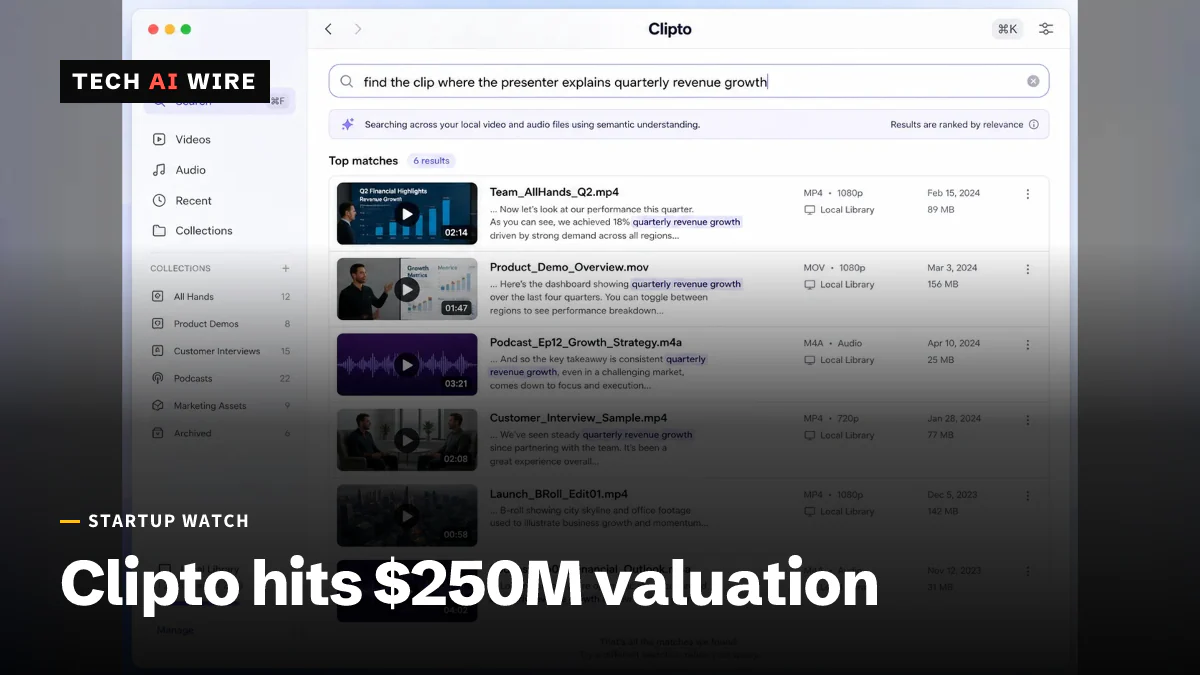
Clipto raises $15M at a $250M valuation for on-device AI search
Clipto said on August 31, 2026 that it raised $15 million at a $250 million valuation. Its search index runs on the user's own machine instead of the cloud.
4 min read
By the numbers
- post-money valuation in the new round
- $250M
- annual recurring revenue, at a net profit
- $15M
- revenue multiple that valuation implies
- 17x
- employees across three offices
- 20+
Clipto said on August 31, 2026 that it raised $15 million at a $250 million post-money valuation. The company builds a search engine for the media files on your own computer, and it says the whole index stays on the machine. That last part is the interesting bit for developers, because it is a bet that local models can carry a paid product.
TechCrunch reports the round was all equity and that Clipto was founded in 2023. Crypto Briefing reports the same $15 million at a valuation above $250 million, and it puts the implied revenue multiple at 17 times.
What the product does
Clipto indexes video, audio, images, meetings, and other files sitting on a user's computer. You describe what you are looking for in ordinary words instead of clicking through folders. TechCrunch describes the indexing as happening entirely on the device, with no cloud step.
An AI assistant can also do the searching for you. According to TechCrunch, ChatGPT and Claude can query Clipto through MCP. MCP is the Model Context Protocol, a standard way for an assistant to call an outside tool or data source. In practice, that turns a desktop app into something an assistant can reach into.
SiliconANGLE, reporting on an earlier round in January 2026, described the technical basis in more detail. It said the company had built more than 10 proprietary multimodal AI models tuned for local inference on laptops and phones. Multimodal here means one model handles several kinds of input, such as pictures and sound, not just text. That report also listed transcript generation for YouTube and TikTok, plus a web platform and a native macOS app.
The money, in order
The three reports describe what look like separate funding events, so the sequence is worth laying out.
| Round | Reported | Amount | Valuation |
|---|---|---|---|
| Pre-A | Before January 2026 | $4 million | Not disclosed |
| Unnamed round | January 6, 2026 | Not disclosed | Above $250 million |
| All-equity round | August 31, 2026 | $15 million | $250 million post-money |
SiliconANGLE reported the January round at a valuation above $250 million, with the amount undisclosed and a $4 million Pre-A round before it. Crypto Briefing describes consecutive Pre-A rounds in 2025 and early 2026, and puts total capital raised at $15 million to $20 million.
The business figures are stronger than the funding history. TechCrunch reports $15 million in annual recurring revenue and profitability on a net-income basis. Crypto Briefing says the company was profitable within three months of launching. It puts the price at about $9 per month. That report also splits the user base roughly a third in the United States and a third in Europe, with the rest in Southeast Asia and Latin America.
The company is small. TechCrunch reports just over 20 employees, with San Francisco as the main office plus Singapore and Hong Kong. Its founder is Henry Kang, who TechCrunch says previously built a clothing-indexing startup and sold ZenVideo to Tencent in 2020. Crypto Briefing names him as Dr. Hongwen "Henry" Kang.
Two figures conflict between the reports, and neither is minor. TechCrunch says more than 30 million people have used the products; Crypto Briefing says more than 10 million. TechCrunch places headquarters in San Francisco, while Crypto Briefing says Palo Alto.
What this means for developers
If you are deciding between cloud API calls and local models for a media feature, this is a data point on the local side. A company with roughly 20 people reached $15 million in recurring revenue and a net profit while running inference on the customer's hardware. The cost structure explains a lot: no per-query bill for indexing terabytes of someone else's video.
The MCP detail is the most copyable part. Clipto did not have to become an assistant. It exposed its index as a tool and let ChatGPT and Claude call it. Maybe you already maintain a local index, a search API, or an internal catalog. An MCP server is then a cheap way to become callable from the assistants your users already have open.
There is a compliance angle worth testing rather than trusting. On-device indexing means media never leaves the laptop, which is exactly what regulated teams need. Before you rely on it, verify it yourself: watch the network while the indexer runs, and confirm the model files are local.
Finally, treat the reported numbers as reported, not audited. The user count differs by 20 million between two same-day reports. Ask the company directly if the scale of its install base matters to your decision.
Sources
Related articles
DeepSeek nears a $15B round backed by Tencent and CATL
DeepSeek is close to raising about $15 billion, or 100 billion yuan, at a $74 billion pre-money valuation, reports said on October 22, 2026.
Flapping Airplanes raises $1B to train AI on less data
Year-old AI lab Flapping Airplanes raised a $1 billion Series A on October 21, 2026, led by Index and Lux. Bloomberg puts its valuation at $6 billion.
Legora raises $550M Series E at an $8.8B valuation
Legora raised a $550 million Series E at an $8.8 billion valuation on October 21, 2026. The legal AI startup says its revenue run rate tops $200 million.
The weekly digest
One email every Friday with the week's top stories from all six desks: AI, dev tools, coding, the tech industry, startups and what's next. Free, no spam.