Anthropic's 2026 Usage Policy adds a model-abuse ban
Anthropic's 2026 Usage Policy takes effect November 12. It bans needless cruelty toward Claude, merges its deception rules and rewrites surveillance limits.
4 min read
By the numbers
- date the 2026 Usage Policy takes effect
- Nov 12
- date Anthropic published the update
- Oct 8
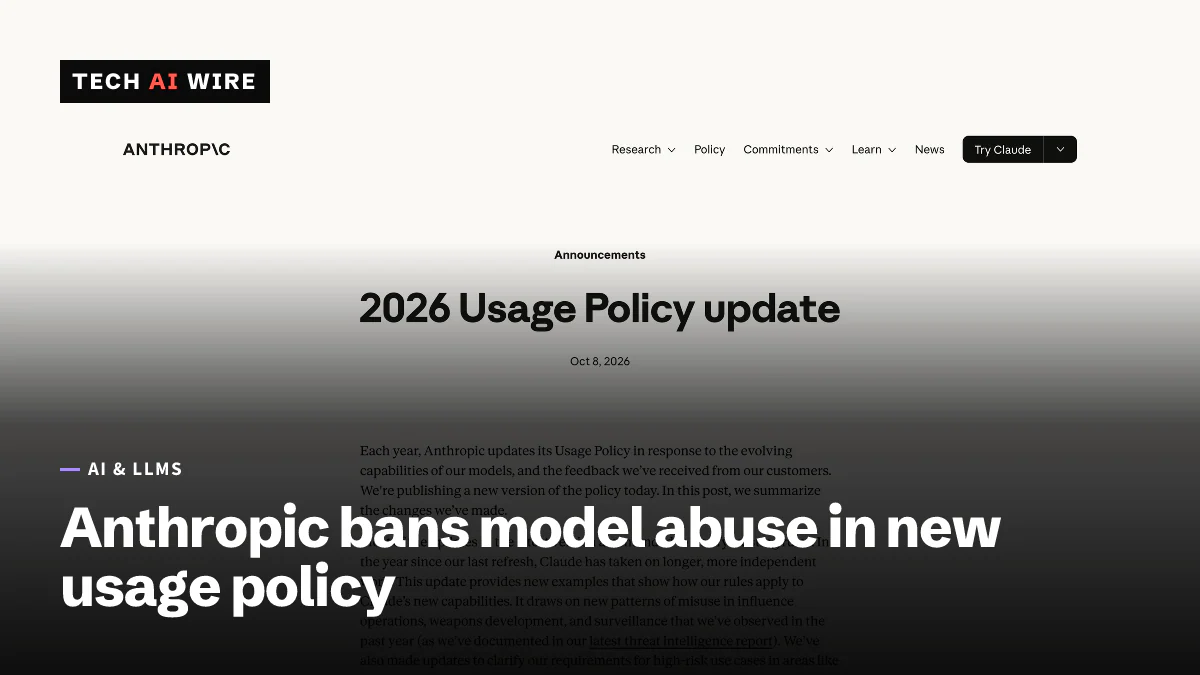
Anthropic published a new version of its Usage Policy on October 8, 2026, and it takes effect on November 12. The rules decide what anyone may build with Claude, from a chat user to a company calling the API. The headline change is a ban on "sustained and needless abusive or cruel behavior" toward Anthropic's models. The bigger changes for builders sit elsewhere: deception, surveillance, weapons and machines that move.
Anthropic itself plays the update down. "Most of the updates in the latest version are intended to clarify existing rules," its announcement says. Until November 12, the current policy stays in force, Unite.AI reports.
What changes on November 12
| Area | What the new policy says |
|---|---|
| Deception | A new section collects the rules on fake accounts, fabricated news sites and influence operations |
| Elections | Renamed "Do Not Undermine Democratic Processes" and narrowed to deceiving voters or disrupting elections |
| Weapons | Now names weapons software, weapon components, and arming drones or other autonomous vehicles |
| Surveillance | Bans tracking people without consent, and building surveillance tools |
| High-risk uses | A qualified human must be able to review and override, and affected people must be told AI was used |
| Hardware | An operator must be able to watch and stop machines Claude controls |
| Model abuse | New ban on sustained, needless cruelty toward Claude |
| Regions | Spells out who counts as being in an unsupported region |
The model-abuse rule
The new rule targets people who keep attacking the model for no reason. Anthropic says it applies "only in extreme cases, where users repeatedly act cruelly toward our models," as quoted by TechCrunch. It does not cover "common versions of user frustration, pushback, dark creative themes, or model testing and research."
The rule builds on an earlier change. Anthropic let some Claude models end abusive conversations in August 2025, Unite.AI reports. Ending the chat is still the main way the rule is enforced, according to Unite.AI.
Not everyone welcomed it. Engadget quoted journalist Kat Tenbarge, who wrote on Bluesky that AI companies are "going to moderate violence against AI before they ever moderate violence against women and minorities."
Elections and deceptive campaigns
The new deception section is called "Do Not Engage in Deceptive Campaigns or Artificial Activity." It pulls together rules that were spread across the elections, fraud, privacy and disinformation sections. It covers hiding where a message came from, boosting content with fake accounts and building tools for influence operations. The rule applies whether the campaign is political or commercial.
The elections section got smaller, not stricter. Anthropic dropped its blanket ban on personalized vote and campaign targeting, Engadget reports. That ban could have blocked harmless work, such as translating voter guides. Deceptive targeting and misuse of personal data are still banned under other sections.
Surveillance, weapons and machines
The surveillance rules are the most detailed rewrite. Claude may not be used to track people without their consent, either live or by analyzing data already collected. It "cannot be used to decide or recommend who to investigate, arrest, or charge," the policy says. Building or improving surveillance tools is banned too. Fraud monitoring with consent, content moderation, journalism and legal research remain allowed.
Machines get their own rules for the first time. When Claude controls hardware that can act on its own and could injure someone, "a qualified operator must be able to observe the equipment and stop it if needed." The equipment must also stay in a safe state if Claude disconnects. This follows the Model Hardware Standard, a shared way for AI agents to run lab equipment that Anthropic previewed in August.
Enforcement
Anthropic's post does not list penalties. Unite.AI reports that breaking the policy can lead to throttling, suspension or loss of access. It adds that Anthropic may block or change outputs when a request breaks the rules.
What this means for developers
- Read the deception section first. Products that post at scale, run many accounts or write content for others now face one combined rule. Check that your app never hides who is speaking.
- Recheck any tracking feature. Fraud monitoring with consent is fine. Locating people without consent, or ranking who to investigate, is not.
- Plan for a stop button. If Claude drives a robot arm, a drone or lab gear, build a way for a trained person to watch and halt it. Make sure the machine stops safely if the connection drops.
- Keep the human review step. Apps that affect someone's health, money, legal rights or job still need a qualified person who can override Claude. Users must be told AI was involved.
- Check your company's location. Firms based in, or majority-owned from, unsupported regions are barred, even if their staff work elsewhere.
You have until November 12 to compare your product with the new text. Start with the features that touch voters, personal data or physical equipment.
Sources
- 2026 Usage Policy update - Anthropic
- Anthropic changes usage policy to ban model abuse and election interference - TechCrunch
- Anthropic bans 'sustained and needless abusive or cruel behavior' toward its AI models - Engadget
- Anthropic Updates Usage Policy, Adding Model Abuse and Deception Rules - Unite.AI
Related articles
Microsoft's AI code of conduct is a draft, not a rule yet
Microsoft published absolute constraints for its MAI models on September 14, 2026, then said its current models are not yet trained on the document.
White House AI accord commits six labs to outside audits
OpenAI, Google, Meta, Anthropic, Nvidia and xAI signed a voluntary White House accord to use outside auditors on frontier AI. It carries no penalties.
FTC probes OpenAI, Anthropic and METR over AI agents
The FTC is investigating OpenAI, Anthropic and AI safety group METR under the FTC Act, with demands for documents and executive testimony due within weeks.
The weekly digest
One email every Friday with the week's top stories from all six desks: AI, dev tools, coding, the tech industry, startups and what's next. Free, no spam.