SAP Cloud SDK for Python bug can leak OAuth2 secrets
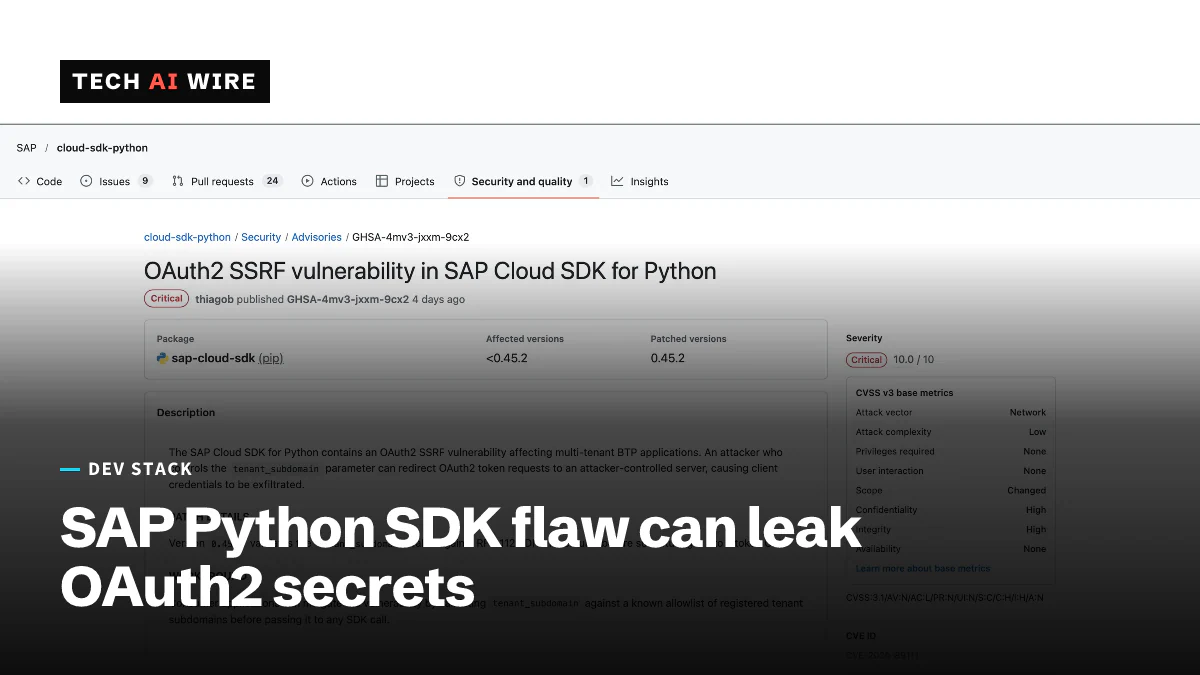
A CVSS 10.0 flaw in SAP Cloud SDK for Python lets attackers redirect OAuth2 token requests and steal app secrets. Version 0.45.2 and later fix it.
3 min read
By the numbers
- CVSS score of CVE-2026-89111
- 10.0
- first patched version, per SOCRadar
- 0.45.2
- critical notes in SAP's October 2026 patch day, per SecurityWeek
- 4
SAP has fixed a maximum-severity flaw in its Cloud SDK for Python that can hand an app's login secrets to an attacker. The bug, CVE-2026-89111, scores 10.0 out of 10 and was patched in SAP's October 2026 security updates on October 13. It affects apps that serve many customers from one deployment, and the attacker does not need to log in.
The SAP Cloud SDK for Python is a library developers use to build apps on SAP's Business Technology Platform, or BTP. BTP is SAP's cloud service for running custom apps alongside SAP systems. The flaw sits in how the library asks for OAuth2 tokens, the short-lived passes an app uses to call other services.
How the attack works
The bug is a server-side request forgery, or SSRF. That means an attacker tricks a server into sending a request to a place the attacker chooses. SAP's GitHub advisory, quoted by SecurityWeek, puts it plainly: "An attacker who controls the tenant_subdomain parameter can redirect OAuth2 token requests."
Here is the chain in plain terms:
- A multi-tenant app builds the address of its token server from a tenant's subdomain, the customer-specific part of a web address.
- The library did not check that value closely enough.
- An attacker supplies a subdomain that points somewhere else.
- The app sends its token request there, with its client ID and client secret attached.
Those two values are the app's own credentials. With them, an attacker can ask for tokens as if they were the app. SOCRadar notes that the flaw does not on its own give admin access or let an attacker run code.
Which versions are affected
SOCRadar lists the versions and fixes:
| Versions | Status |
|---|---|
| Below 0.45.2 | Vulnerable |
| 0.45.2 | Official fix: checks the subdomain against DNS naming rules |
| 0.53.0 to 0.55.0 | Validation gap reported independently, outside SAP's advisory |
| 0.55.1 | Validation restored |
The 0.53.0 to 0.55.0 gap comes from SOCRadar alone. SAP's advisory does not cover it, so treat 0.55.1 or later as the safe floor. The project's GitHub page lists 0.60.1 as its newest release, dated October 17. That release fixes a separate URL path injection bug in a document client. An October 9 release also fixed how tenant token URLs are built.
SOCRadar said on October 14 that no attacks had been reported. SecurityWeek also says SAP reports no exploitation in the wild.
The rest of SAP's October patch day
The SDK flaw was one of four critical issues, BleepingComputer and SecurityWeek report:
| CVE | Product | Score | Problem |
|---|---|---|---|
| CVE-2026-89111 | Cloud SDK for Python | 10.0 | OAuth2 SSRF, no login needed |
| CVE-2026-89110 | NetWeaver Visual Composer | 9.9 | Broken access control |
| CVE-2026-89107 | S/4HANA | 9.9 | Code injection by users with one Fiori role |
| CVE-2026-89108 | Manufacturing Integration and Intelligence | 9.1 | Missing authorization check |
The outlets count the batch differently. BleepingComputer says 20 flaws, SecurityWeek says 22 new and updated notes, and SOCRadar counts 16 new notes plus four GitHub advisories.
What this means for developers
If you ship a multi-tenant BTP app in Python, check your dependency file today. Search for the SDK and note its version. The fix is a library upgrade, not a server patch, so it only reaches users when you redeploy.
- Upgrade to the latest release, which is past both 0.45.2 and 0.55.1.
- Allowlist tenant names if you cannot upgrade yet. SAP's advisory recommends "validating tenant_subdomain against a known allowlist," BleepingComputer reports.
- Rotate the client secret if you have any doubt. SOCRadar advises reviewing OAuth2 token traffic and BTP audit logs. If you see token requests to unknown hosts, assume the secret is gone.
- Look at your own input handling. Any code that builds a URL from a customer-supplied value has the same shape of risk, whatever library it uses.
Single-tenant apps that never take a subdomain from user input are much less exposed. But a CVSS 10.0 score in a library is easy to miss, because no SAP server patch will fix it for you.
Sources
- SAP warns of maximum severity OAuth2 SSRF security flaw - BleepingComputer
- SAP Patches Critical NetWeaver, S/4HANA Vulnerabilities - SecurityWeek
- CVE-2026-89111: Critical SAP Cloud SDK SSRF - SOCRadar
- SAP Cloud SDK for Python releases - GitHub
Related articles
OpenCode Console breach exposes stored AI provider keys
OpenCode says a breach hit 1.4% of OpenCode Console users on October 17, 2026. Their stored OpenAI, Anthropic and Google API keys may have leaked.
GitHub license compliance is generally available
GitHub's open source license compliance became generally available on October 16, 2026, letting rulesets block pull requests that add unapproved licenses.
GitHub App installation tokens are now 520-character JWTs
GitHub finished moving App installation tokens to a stateless format on October 2. They now run about 520 characters, up from 40, and old checks may break.
The weekly digest
One email every Friday with the week's top stories from all six desks: AI, dev tools, coding, the tech industry, startups and what's next. Free, no spam.