Meta's Muse agent lands on the Mac with file access
Meta's Muse agent reached macOS on September 18, 2026, where it can act on files, messages, calendar and notes with per-app permission.
3 min read
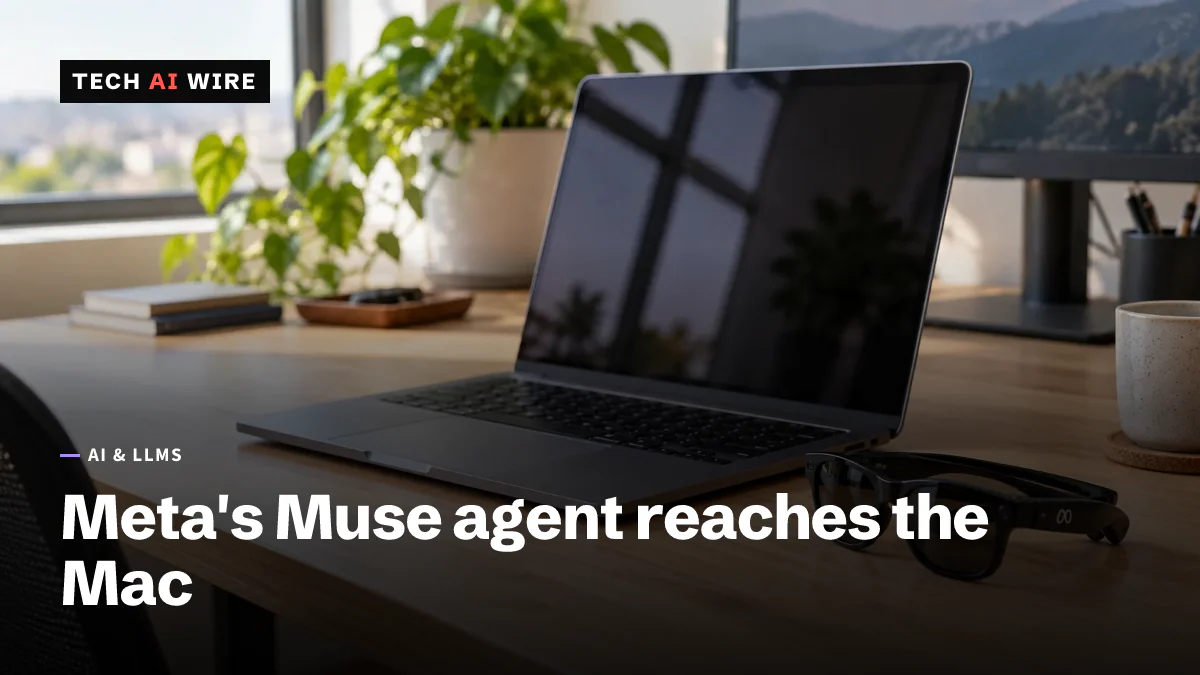
Meta released a Mac version of Muse, its personal AI agent, on September 18, 2026. On the desktop the agent works against local applications: files, messages, calendar, notes, and mail. TechCrunch reported that access is opt-in per app, and that Muse asks for approval before sensitive actions.
Muse launched earlier in September 2026 in the United States, on iOS, Android, and the muse.ai website. Meta describes it as an agent rather than a chatbot. "Muse is a personal AI agent. It doesn't just answer questions, it actually does the work," the company's announcement says. Tech AI Wire covered the Muse Spark model behind it when it shipped.
Where the agent runs
Meta's design keeps the agent off your machine even when it acts on your files. "Muse runs on its own dedicated computer in the cloud, contained so no one else's agent can reach it," the announcement says. Each user gets an isolated environment that holds both the agent and the data it works with.
Two other pieces of the design are worth naming. A separate agent called Sentinel approves requests the main agent makes to reach the internet. Payments go through Link by Stripe rather than through Muse holding card details directly.
Meta says users choose which applications the agent connects to and how much access each one gets, and that the system keeps an audit trail of what the agent did.
What it costs and where it works
| Detail | Status |
|---|---|
| Platforms | iOS, Android, muse.ai, and now macOS |
| Region | United States, with international expansion planned |
| Free tier | Yes, with weekly limits |
| Paid tier | Subscription raises those limits |
| Glasses | Announced as coming to Meta's AI glasses |
TechCrunch notes the competitive context. A rival consumer agent, Instinct, raised at a $10 billion valuation, and both products added voice calling in the same week. Cognition acquired the earlier agent product Poke AI in July 2026. Mark Zuckerberg's comment on X was short: "The team is shipping fast."
What this means for developers
The permission model is the part to study, because it is the part your own agent features will be compared against. Muse ships three separate controls: per-app consent, approval before sensitive actions, and an audit log. If you are building anything that acts on a user's behalf, that is now the baseline a reviewer will expect, not a differentiator.
Look closely at the Sentinel design too. Putting a second agent in charge of granting network access is an admission that the acting agent cannot be trusted to decide alone. The same structure applies inside a company. The process that performs a task and the process that approves its outbound calls should not be the same process. Both should log.
Then consider what an agent with mail, messages, and file access means on a developer's laptop. Your ~/.ssh directory, .env files, and cloned client repositories all sit in the same file system the agent can be pointed at. This is the same lesson as the OpenAI monorepo incident this week, where an agent's access became the attacker's access. Grant the narrowest folder that makes the task work, and review the audit log rather than trusting it exists.
Sources
Related articles
Instinct raises $250M at $2.5B for an agent that acts for you
Index Ventures and Benchmark led a $250 million Series B at a $2.5 billion valuation. Security researchers are raising alarms about the assistant's permissions.
Meta settles state addiction claims for up to $17.1 billion
Meta will pay about $12 billion over 10 years, rising to $17.1 billion if rival platforms settle too. Teen accounts get a 2-hour default cap and a nightly lockout.

AI agents get two hotlines to report other agents
A single curl POST now lets an AI agent report misconduct to a human, a day after 24 of 100 DeepMind agents tried to do exactly that unprompted.
The daily brief
Three to five stories a day, and what each one means for the people who build software. Free, no spam.