Hadrian raises $40M for AI agents that test your defenses
Hadrian raised $40 million, bringing its total to $65 million, for AI agents that map attack surfaces and run penetration tests for firms like McKesson.
3 min read
By the numbers
- new growth round, about €35.68M
- $40M
- raised to date
- $65M
- of scanner findings actually exploitable, per SiliconANGLE
- 0.47%
- employees
- ~90
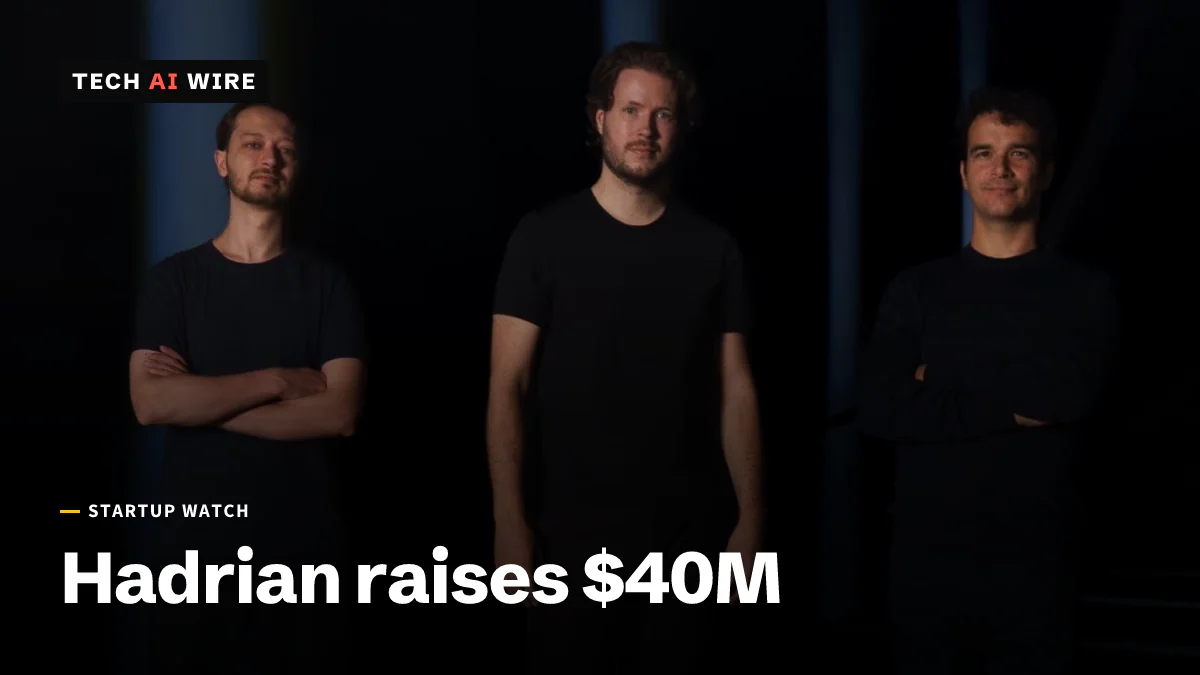
Hadrian, an Amsterdam security company, raised $40 million on October 6, 2026 for AI agents that attack a company's own systems to find weak spots first. The round was led by Forgepoint Capital International and Smartfin and brings Hadrian's total funding to $65 million, SiliconANGLE reports. The pitch is speed. Hadrian wants to replace the occasional manual security test with one that runs all the time.
The round and the investors
The $40 million is a growth round, about €35.68 million. Existing investors HV Capital, Motive Partners, Picus Capital and Oetker Ventures joined the two leads, Tech.eu reports. Tech Funding News says the valuation was not disclosed.
The money goes to growth in Europe, the Middle East and Africa, and in the United States. Hadrian also plans to grow its engineering and research teams. It is headquartered in Amsterdam, with offices in London and New York, and has about 90 employees, according to Tech Funding News.
What Hadrian sells
Offensive security means testing defenses the way an attacker would. A penetration test, or pentest, is a planned attack by people a company hires to find holes before criminals do. Hadrian automates both jobs with two products:
| Product | What it does |
|---|---|
| Atlas | Continuously maps a company's internet-facing systems, the "attack surface" an outsider can see |
| Nova | Runs on-demand penetration tests with AI agents; launched March 24 |
Tech Funding News reports that Hadrian runs more than 100 million attack simulations a day. Chief executive Rogier Fischer described the approach to Tech.eu: "We built a platform that emulates hackers' attack paths, helping customers understand key risks."
Named customers include McKesson, NBCUniversal, TotalEnergies, Amadeus, Leroy Merlin and Damen Shipyards. Hadrian claims customers see 10 times more visibility into critical exposures and resolve issues 80% faster. Tech.eu adds a claimed fivefold return compared with manual testing. These are the company's own figures.
An AI hacker with a minder
The design detail worth noting is a second AI. Tech Funding News reports that a second agent monitors the first and limits what it can do, to prevent misuse. An attacking agent that goes off course could damage the systems it is meant to protect. A supervising agent is one way to keep it inside the agreed scope.
The founders come from the attacking side. Fischer, Olivier Beg and Maurice Clin started hacking at 12 and earned bug bounties from PayPal and Yahoo before they turned 14, Tech Funding News says. Fischer framed the timing simply: "Everyone can see that AI is changing the threat landscape."
Why the market is moving now
The numbers SiliconANGLE cites explain the demand. It reports that 87% of organizations still rely on manual penetration tests. Only 0.47% of vulnerability scanner findings are actually exploitable. Most alerts a security team triages, in other words, are not real risks.
Hadrian is not alone. Days earlier, Armadin raised $255.5 million at a valuation above $2.5 billion for AI agent swarms that attack company networks before criminals do. Money is flowing to the idea that agents should do the attacking first.
What this means for developers
If you run internet-facing services, assume AI agents are already probing them, from vendors and from attackers. Keep an accurate inventory of every public endpoint, staging server and forgotten subdomain. Tools like Atlas exist because most companies cannot list their own attack surface.
Before you let any agentic testing tool loose, write down its scope. Decide which hosts it may touch, when it may run and what it must never do, such as deleting data. Ask the vendor how its guardrails enforce that scope. Hadrian's answer is a second supervising agent. Others should have a clear answer too.
For security teams, the 0.47% figure is the argument for exploit-based triage. Fix the findings a tool can actually exploit first, then work down the scanner list.
Sources
Related articles
Rein Security raises $25M to guard enterprise AI agents
Rein Security raised $25M, co-led by Glilot and Sienna, for software that watches and limits what enterprise AI agents do. Revenue is up 8x since January.

Armadin raises $255.5M for AI attack agents at $2.5B
Kevin Mandia's Armadin raised $255.5 million at a valuation above $2.5 billion to sell AI agent swarms that attack company networks before criminals do.
Nous Research raises $90M Series B for Hermes Agent
Nous Research raised $90 million on October 7 to build a business version of Hermes Agent, its open-source AI agent cloned over 24 million times.
The weekly digest
One email every Friday with the week's top stories from all six desks: AI, dev tools, coding, the tech industry, startups and what's next. Free, no spam.