Anthropic report: junior tech hires fell from 27% to 9%
Anthropic says junior roles fell from 27% to 9% of its technical hires, and its staff's AI agents logged six hours for every employee hour by August 2026.
3 min read
By the numbers
- junior share of Anthropic's technical hires
- 27% to 9%
- interactive agent hours to employee hours, August 2026
- 6:1
- code commits per engineer versus six months earlier
- ~5x
- median employee meeting time, year over year
- +20%
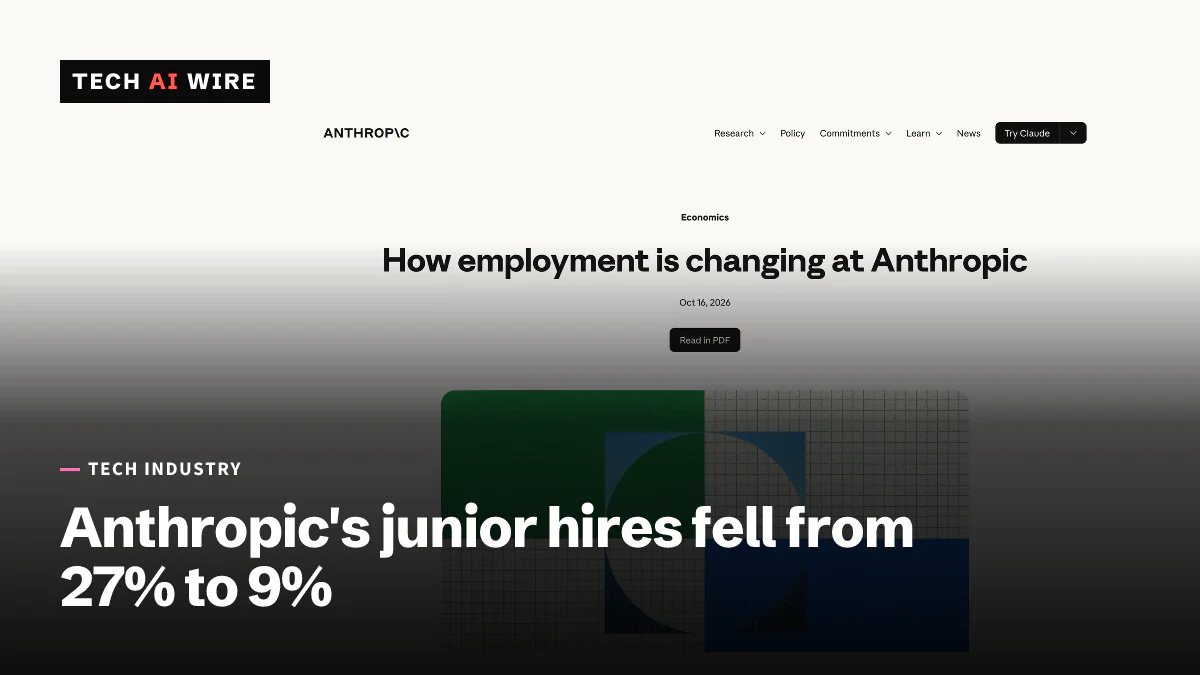
Anthropic published a report on October 16, 2026, showing how its own AI tools have changed who it hires and how its staff work. Junior roles fell from 27% to 9% of its technical hires. By August, agents directed by employees were logging six hours of work for every employee hour. The company calls itself a "leading indicator" of what AI could do to jobs elsewhere, which makes the numbers worth reading beyond Anthropic.
The report, titled "How employment is changing at Anthropic," was written by Nathan Wilmers, Regina Catipon, Maxim Massenkoff and Peter McCrory. It draws on headcount data, agent usage logs, surveys, calendar data and 17 employee interviews.
Fewer junior engineers
The shift shows up first in hiring. The report gives these figures:
| Measure | Before | Now |
|---|---|---|
| Junior share of technical hires | 27% | 9% |
| Junior share of technical staff | 21% (early 2025) | 14% |
| Technical teams' share of all staff | 61% | 56% |
About one-third of machine-learning managers and one-fifth of software-engineering managers said in April 2026 that they hire less because of AI. Anthropic now has about 17 engineers for each product manager, up since 2025.
Coding is spreading beyond engineers. Non-technical employees ran two coding-focused agent sessions a month in August 2025, the report says. By May 2026 that had risen to 90 a month.
Agents outwork people, and wait for them
Agent work passed human work hours across the company in March 2026. By August, interactive agent sessions started by employees ran six hours for every employee hour. Code commits per engineer reached about five times the rate of six months earlier.
Yet the agents spend most of their time waiting. About 80% of interactive Claude session time is idle, waiting for a human to respond. One engineer described "an army of Claudes, with every one asking for my attention." Another said people are "bottlenecking the agents."
Managing agents has become a job of its own. Written standing instructions for agents grew from a few hundred in July 2025 to 8,500 about a year later. The share of sessions spent on this "meta-work" rose from 10% in fall 2025 to 22% in spring 2026.
More meetings, not fewer
Median meeting time per employee rose 20% from a year earlier, and 16% for technical staff who are not managers, TechCrunch reports from the report. The report argues that human attention, judgment and face-to-face coordination are now the main bottlenecks.
In an open-ended April 2026 survey, 27% of employees described productivity gains from Claude tools. Another 20% said their job had shifted toward managing Claudes.
What Anthropic recommends, and the limits
The report recommends broad employee stock ownership. It also calls for an early-warning system for roles at risk, with staff moved to new internal jobs. It warns against "so-so" automation that cuts jobs without making work much better. Private employers alone cannot fix the slowdown in junior hiring, it says.
The authors list their own caveats. Anthropic is one AI company and may not represent others. Early tool users were already on fast-growing projects, and more code does not mean better code. TechCrunch also notes the findings are company-authored and partly self-reported. Outside Anthropic, the Federal Reserve's October Beige Book reported AI slowing hiring in five districts.
What this means for developers
- Junior engineers need a new entry route. If AI-heavy teams hire fewer juniors, early-career developers should show they can direct and check agents, not only write code. Anthropic's interviewers now look more often at candidates' record with AI tools.
- Plan for review, not typing, as the bottleneck. With agents idle 80% of the time, the scarce resource is a person who can review their output. Teams adopting agents should budget review time first.
- Count the hidden management work. Instruction files and agent supervision took up 22% of session time at Anthropic. Track that cost when you measure what agents save.
- Expect more coordination, not less. Meeting time rose 20%. Leaders rolling out agents should plan for more decisions reaching people, not fewer.
- Read company-run studies with care. These figures come from an AI vendor studying itself. Use them as a direction to watch in your own team's data, not as a forecast.
Sources
Related articles
Replit CEO says it dropped Anthropic; insider disputes it
Replit CEO Amjad Masad said on October 16, 2026 that Replit no longer works with Anthropic, citing cost and performance. A source says the deal stands.
Claude Code 2.1.277 reads AGENTS.md as a fallback
Claude Code 2.1.277 reads AGENTS.md when a project has no CLAUDE.md. Over 60,000 open-source projects already ship that file.
FTC probes OpenAI, Anthropic and METR over AI agents
The FTC is investigating OpenAI, Anthropic and AI safety group METR under the FTC Act, with demands for documents and executive testimony due within weeks.
The weekly digest
One email every Friday with the week's top stories from all six desks: AI, dev tools, coding, the tech industry, startups and what's next. Free, no spam.