AfterQuery hits $3.2B, reportedly YC's fastest unicorn yet
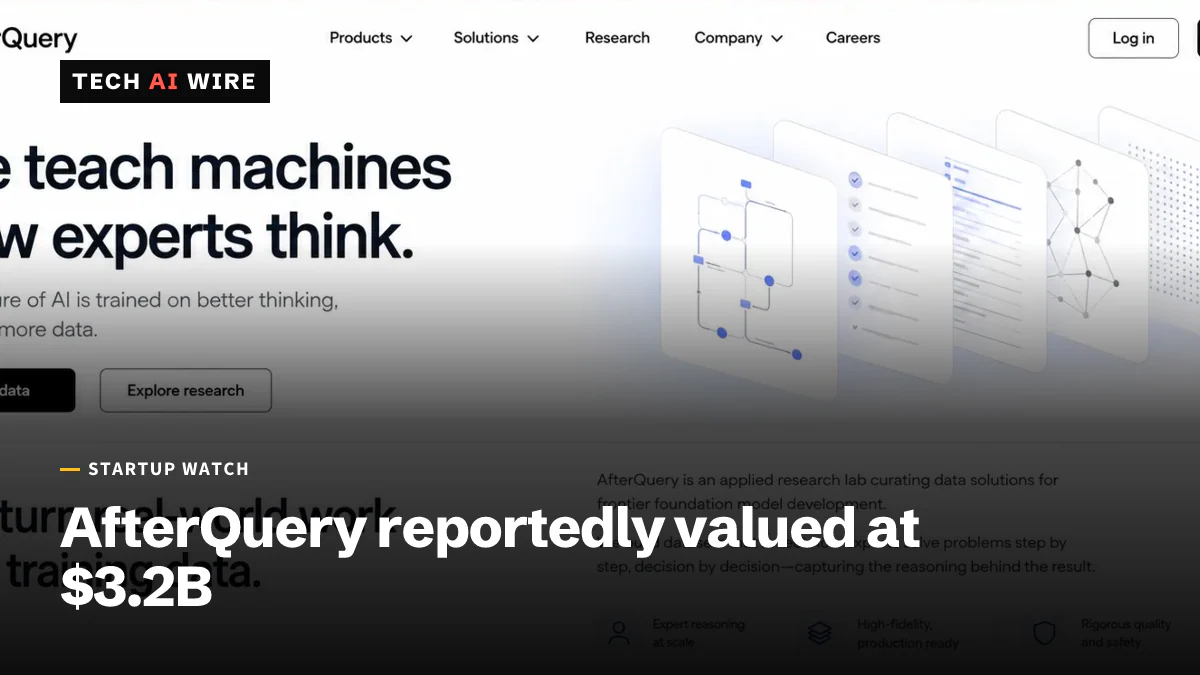
AfterQuery is reportedly valued at $3.2 billion, up from $300 million in April. It sells the professional reasoning data that labs use to train AI agents.
3 min read
By the numbers
- reported valuation, up from $300M in April 2026
- $3.2B
- annualized revenue run rate, as of April 2026
- $100M
- the Y Combinator batch the founders came from
- W25
- April 2026
- 300
- September 2026
- 3200
AfterQuery, a startup that sells training data to AI labs, is now valued at $3.2 billion, TechCrunch reported on September 1, 2026. That is up from $300 million in April 2026, five months earlier. Y Combinator partner Gustaf Alströmer described it as "the fastest that any startup has gone from launch to unicorn status" in the accelerator's history.
One caution before the numbers. Both TechCrunch and Dealroom describe the round as reported rather than confirmed by the company, and neither gives its size.
What AfterQuery actually sells
The product is data, but not the kind most people picture.
Most AI training data is about getting answers right. AfterQuery is selling something narrower. TechCrunch describes the company as training models and agents on how professionals would work to complete a task. The company's own phrase for this is "encoding the patterns, decisions, and reasoning of the world's best practitioners."
Dealroom describes the same business as building datasets focused on high-end human reasoning.
The distinction matters. A model can know the correct answer to a legal or financial question and still have no idea of the sequence a practitioner follows to reach it. That sequence is what an agent needs, because an agent has to take steps rather than produce one reply. Demand for that data has grown as labs shifted from chatbots to agents.
TechCrunch names three customers: Nvidia, Legora and the Korean AI lab Motif Technologies.
The numbers behind the jump
The rise is steep even by current standards.
| Point | Figure |
|---|---|
| Valuation, April 2026 | $300 million |
| Series A, April 2026 | $30 million |
| Valuation, September 2026 | $3.2 billion, reported |
| Annualized revenue run rate | $100 million, as of April 2026 |
| Y Combinator batch | Winter 2025 |
| Founders' ages | 22 and 23 |
The $100 million figure needs reading carefully. TechCrunch reports it as an annualized run rate as of April 2026. A run rate takes recent revenue and projects it across a year. It is not $100 million already collected, and the April date means it is five months old.
The two sources differ on detail. TechCrunch gives the April Series A as $30 million and names the Winter 2025 batch, while Dealroom omits both. Dealroom names one founder, Spencer Matega, aged 23. TechCrunch gives the founders' ages as 22 and 23 without naming them. Dealroom reports no revenue figure at all.
What this means for developers
The signal here is about what agent builders are short of, and it is not model capability.
If a $3.2 billion valuation is being paid for recorded professional workflows, the constraint labs are buying their way out of is process data. Models can already produce competent answers in law, finance and medicine. What they lack is the ordered sequence of checks a practitioner performs. That gap is worth noticing if you are building an agent and finding that it reaches plausible conclusions by the wrong route.
There is a practical version of this for your own work. If your agent keeps skipping a step that your experienced colleagues never skip, the fix is usually not a better model. It is writing down the sequence those colleagues follow and putting it in the prompt or the tool design. AfterQuery's whole business is that this knowledge is rarely written down anywhere.
Treat the valuation itself with more caution than the trend. The round is reported, not announced, and no round size has been published. Revenue is a run rate from April. A company can be genuinely growing fast and still be valued on a multiple that later looks strained.
Watch for a second-order effect on your own data. Companies paying for expert reasoning data will look for it wherever it already exists, and internal runbooks, support transcripts and code review histories are exactly that. If your employer starts asking about licensing operational records, this market is the reason. Read what you are agreeing to before that conversation reaches your team.
Sources
Related articles

Instinct raises $250M at $2.5B for an agent that acts for you
Index Ventures and Benchmark led a $250 million Series B at a $2.5 billion valuation. Security researchers are raising alarms about the assistant's permissions.

Rillet hits a $1B valuation two years after leaving stealth
AI-native ERP startup Rillet raised a $100M Series C led by ICONIQ at a $1B valuation - its third round in 14 months, closed in under 48 hours, with 600+ customers.
Crusoe reportedly raises $3B at a $30B valuation
Crusoe has reportedly raised $3 billion at a $30 billion valuation, three times its October 2025 mark, after signing a $13 billion cloud deal with Jane Street.
The daily brief
Three to five stories a day, and what each one means for the people who build software. Free, no spam.